…i’m no longer friends with the person who i used to send thousand+ word rants about all the stuff i’m writing with the spoiler limits off 

she’d send the entire email back copy-pasted with long responses in a different color added in at the end of nearly every paragraph 

…i’ve never found anyone else who would do that. most people just give the barest token amount of polite attention and then immediately forget everything. 

i shouldn’t have taken her for granted :

Hey! For your headcanons, have anything on Post Brotherhood/ Human Al?

ninthfeather:

Headcanon A:  realistic

Although his muscle tone returns to normal with time and physical therapy, one more permanent souvenir of Al’s time in the Gate is his somewhat lacking immune system. It’s able to fight off infection, but it takes longer about it than a normal person in his state of health, for the simple reason that it spent years without being exposed to a single virus or bacteria. So Al catches every single cold that passes through whatever location he’s in, and makes Ed panic repeatedly.

Headcanon B: while it may not be realistic it is hilarious

Al really enjoys having physical sensation back–perhaps sometimes to excess. Specifically, he really likes the feeling of rain on his skin and so he will deliberately “forget” his umbrella and raincoat, even when it’s seriously pouring.  Of course, his traveling companions worry, so it’s just two hulking men with somewhat animalistic features chasing after a laughing, fresh-faced young man with umbrellas. It’s even worse if he’s with Ed, since Ed’s old injuries mean he hates rain and gets progressively grumpier as the weather gets worse, so Al’s antics just end in him screaming at his brother to “Put a f***ing raincoat on, idiot!”

Headcanon C: heart-crushing and awful, but fun to inflict on friends

Sometimes Al wonders if Ed resents him. He knows how much his brother loved alchemy.  And yes, he always says that Al is more important to him, but how can Al know for sure that’s true? Ed’s a master of self-deception, he has been all his life. He might not even be lying to Al on purpose. These moments of doubt don’t last long, but they always cut deep.

Headcanon D: unrealistic, but I will disregard canon about it because I reject canon reality and substitute my own.

Al gets a cat.  Also, at some point in his travels with the ex-military chimera, he also meets a lovely old lady with roughly 26 cats and takes a picture with them in order to convince Ed that he’s adopted all of them.  He keeps up the charade for months.

headcanon ask meme

ignitesthestars:

okay but lucretia has a very dry, almost surprising sense of humour? like it’s very at odds with her Gravitas.

and i just really love the idea of her having been Serious Madame Director for the majority of the Bureau’s existence

and then these three idiots show up and all of her underlings are just sort of gaping at this ‘Goddamn we love domes around here’ weirdness coming out of their Fearless Leader’s mouth because the truth is that her friends are back and if she has to pretend not to know them, she can’t quite help but regress a little bit in spite of herself.

oops i hope you don’t mind me asking but do you have any taz fic recs?? preferably taako-centric? doesnt have to have taakitz or from his pov. Thank you, queen of writing!

anonymousalchemist:

marywhal:

I can certainly rec some Taako-centric fics! I love my boy and I have read a lot of my boy. These are on the shorter side because I just posted a list of some of my favourite long fic, but they’re all very, very good. I also refrained from adding WIPs to this list or it would definitely look different! 

crack your bones with veins of gold by @mcgonagollygee (Rated: Teen) 
Summary: In a hundred years, one tends to see their friends die a lot. It doesn’t get easier, except it kind of does.
Notes: Taako and Barry’s friendship is one that doesn’t get explored nearly enough in fic. This is by far the best fic I’ve ever read that explores their dynamic. The author writes possibly my favourite Barry, and the dynamic this fic sets up between him and Taako is excellent. It’s a vignette exploration that stretches through stolen century to post-canon. (TW: There is a lot of death in this fic. I mean, it’s stolen century.)

Cycle 71 by @mystery-moose (Rated: Gen) 
Summary: A hundred years, a hundred worlds, a hundred stories. The seventy-first starts off poorly (though not nearly as poorly as some) and honesty, like violence, can be brutal.

Taako is fed up. Magnus feels guilty. Lup lashes out. Merle saves the day.
Notes: This is one of my all time favourite TAZ fics so I know I’ve rec’d it before, but you asked for Taako recs and one of the things I love about this fic is how vicious Taako’s allowed to be. This is a Taako who has complete faith in his crew and his sister and who is pissed off at the circumstances he finds himself in. This is a Taako with what is, to me, perfect stolen century characterization.

in chambers dark, through mirrors dim by @lichlesbian (Rated: Teen)
Summary: The paranormal has never really been Taako’s jam.
Astrology, magic, regenerative gemstones and tarot cards—they’re all
very well in his wheelhouse, but he’s never had any particular
inclination to believe in the existence of ghosts.

Then again, according to the stunningly handsome man standing in their living room, it isn’t a ghost they’ve summoned.
Notes: Okay, so a thing you need to know about me is I love ghosts. Like, a lot? Like I wrote a thesis about ghosts and my irl friends regular refer to me as their “ghost friend” and send me links to basically anything to do with haunting. This fic is so explicitly my jam it’s ridiculous. Taako here is funny and cocky and willing to stand up to Literal Death for his friends. It’s a super cute fic and a very fun read.

lock & key (series) by @anonymousalchemist (Rated: Teen) 
Summary: Taako gets drunk, doesn’t talk about his feelings, cries all over his boyfriend. Kravitz doesn’t get drunk, feels an emotion, gets cried over.
Notes: You may be able to tell, from the other fics on my list, that angst isn’t a genre of fic I spend a lot of time reading. There’s a lot of very good Taako angst out there, but honestly? The author does an excellent job of what is for me the exact right balance of emotion and repression in Taako, and I love how concerned Kravitz is about this. The series is a really good exploration of Taako’s character and, honestly I think Iz has one of the strongest grasps on Taako’s voice in the fandom. I highly recommend reading her backlog because I honestly had to stop myself from also reccing Old Man Taako and TAAKOQUEST.

The Teenagers Guide to Gambling for Fun and Profit by @terezis (Rated: Teen) 
Summary: Kravitz finds himself in a bit of a pickle. Lup makes some calls. Taako strikes a deal.
Notes: So playing into Kravitz’s gambling habit is, no surprise, one of my favourite things. This fic follows Taako as he stages a mission to rescue Kravitz, who may have gotten himself in over his head. It’s funny and sweet and an excellent take on post-canon Taakitz. Taako loves his boy, but he’s also rightfully exasperated with his behaviour and gambling habits. Taako’s negotiating here is spot on and i absolutely adore the author’s portrayal of Taako and Kravitz’s relationship here.

!!! oh shit thats me! 

ive read most of this except for mine cause i wrote mine and dont want to read it cause fuck reading your own stuff, and CAN CONFIRM its good 

also op writes a killer taako so yanno. 

I just found and binged your writing and it’s so good! I love your TAZ fic. I wondered do you have any recommendations for more good good fics like yours?

anonymousalchemist:

mystery-moose:

Oh my god, anon, this is such a compliment, holy shit. ‘Scuse me while I preen for a moment.

AND NOW ONTO ANOTHER EDITION OF TAZ FIC REX

Okay, so. I did put together a big fic rec list a while back, and I still stand behind ALL of those fics, they’re GREAT and people might not have read them since they were written pre-finale. But, on the other hand, that list was compiled pre-finale, and there’s been so much great work since then. I kind of fell off reading fic for a while, first because I was too busy writing it, and then because I was too busy with school, and now because… well I’m too busy with school, BUT. I can make some more modern recommendations.

First of all, pretty much anything by @anonymousalchemist is worth reading. They have a super distinct voice, an incredible handle on dialogue and characterization (especially Taako) and they get into some weird weird eldritch meme-y shit that no one else has the COURAGE or the CHUTZPAH to write.

Secondly, she’s in the old list but deserves to be mentioned again: goodnicepeople is a preternaturally gifted writer. She’s written some of the most moving, beautiful pieces I’ve read PERIOD, let alone TAZ. Patterns of Migration (and all of her work really) made me care about Magnus as a character in a way I just didn’t before, and Like an Open Book directly inspired my love of Angus-and-Taako reluctant-parent thing. She is a gift and a treasure and her work elevates this community purely by association. I can’t say enough good things about her.

And there’s plenty of other talented writers – @emi–rose has done some killer collabos with anonymousalchemist, @marywhal has written some fantastic stuff (including a long recipe-based fic that I still have bookmarked to read both for the story AND the recipes) and @epersonae has a handle on writing Lucretia’s character and inner voice that I envy. Oh, and @inkedinserendipity has a way with words that’s just… chefkiss. Just some smooth, beautiful prose I wish I could emulate.

As for specific fics…

Luster is a big one that made the rounds a while back. It’s over 100k, and has some fantastic characterization, a compelling plot, some truly kickass worldbuilding (the things Taako does with magic are a huge inspiration to me personally; it’s so smart and he comes off exactly as powerful and intelligent as he should by all rights be) buuuuuuuuut it’s also a) unfinished and b) has some segments that are really hard to read, not because of quality but because of the tension and raw emotion of the thing. I’ve been waiting for it to finish before I read the rest of it, purely because I need to know the catharsis is coming, y’know? But it’s still a tremendous achievement regardless of if it’s ever done or not.

Fortune’s Favor is one of my all-time favorites. It’s got a nice premise, but the way in which it goes about telling it is what makes it special. Beautiful prose, evocative imagery, wonderful characterization. It was a part of my personal canon for a while purely because of how well it’s told. Might still be, depending on the mood I’m in!

the last time somebody mentions your name is, in my mind, a sister piece to goodnicepeople’s work. But it’s very much its own voice, and making comparisons between them does both works a disservice. weatheredlaw is an extremely talented writer in their own right, and their version of a similar story is just as beautiful.

something that death can touch is an excellent fic with fabulous characterization, specifically for Taako. I believe it was written just pre-finale, and so a lot of the details are different, but some of those details (the name of Taako’s restaurant, his complicated relationship with Kravitz) are so spot on and so perfect that for a while I was actively jealous I hadn’t thought of them. And yeah, it’s yet another “grief and mourning” story, but it doesn’t linger there, or doesn’t feel like it does. There’s a great sense of progress to the story, of forward movement and healing that I appreciated. (That being said, it’s been a long time since I read it. Maybe it’s a bit harsher than I remember!)

And now you have to put up with my het rarepair bullshit, because Home, Home, Home is honestly one of my favorite little relationship pieces. The mood it creates is so soft. Sometimes I go back to it just to relax.

Right now, I think that’s all I got! I know there’s more, probably plenty I forgot to bookmark (including a recent Kravitz-centric piece by Mango that was a huge inspiration for me) and almost certainly TONS more that I just haven’t read since I fell off that wagon. But every one of these is a fabulous piece that’s absolutely worth your time. And you can take that to the BANK.

THANK YOU FOR BACKING ME AS THE ONLY NON-COWARD IN THIS FANDOM

(jk but also ❤ ❤ for real) 

PTSD as a result of abuse in early development.

jenroses:

primarybufferpanel:

hollowedskin:

hollowedskin:

PTSD is a chronic illness and depending on your history, it might never be gone completely. Especially if that trauma was ongoing and happened young, before your brain is fully formed. And thats pretty much any age under 25.

25!? Yeah.
So the reason the shit that happened when you were a pre-teen or a teenager? That’s why it’s still not ok.
That’s why you might not be experiencing your expected results from therapy, because it’s not enough to treat your trauma as though you are/were an adult.

Popular theory states that it’s only in early childhood development that ongoing trauma or abuse* forces physical and permanent changes in the brain, because it’s still forming.

But the fact is that human brains aren’t fully formed until adulthood
(which can be between 18 and 25 – the same reason you can’t get car insurance till then and why they say you shouldn’t drink) and this extreme trauma forces the brain into what is essentially a ‘reset’ state, where it then adapts to the environment of constant abuse and is harmed in exactly the same way.

 (*Abuse can be physical, sexual, emotional, mental, or environmental (neglect, emotional neglect etc), and/or being witness to extreme ongoing abuse of someone else.)

So what’s the damage?

Well there is a few things that happen.

Trauma affects what children anticipate and focus on (y’all are children till you’re adults in terms of brains remember), and how you can view and understand the information that you receive.

Changes in how you perceive threats because of trauma end up being expressed in how you think, feel, behave and even how you regulate your biological systems.

This presents in problems with

  • self regulation (being able to start or stop doing something when you think you should, overeating or over-doing anything really is a good example of this)
  • aggression against themselves and others
  • problems with attention and dissociation
  • physical problems (I will expand upon this later)
  • difficulties in self concept (who am I, what am I, believing you have worth, believing you are a person, etc)
  • and the capacity to negotiate satisfactory interpersonal relationships. (Why do I keep ending up in abusive relationships, why can’t I make friends or connect with people etc)

Trauma is so powerful because the amygdala starts functioning almost immediately after birth; children rapidly are able to experience fear and assess danger. Babies get scared even when they can’t think properly because of this.

Basically, early abuse and neglect can affect the development of the limbic system which makes individuals with traumatic histories to become highly sensitive to sensory input, which is known as hypervigilance.

Your amigdala is part of the limbic system that controls instinct, your “lizard brain” that keeps you safe and controls your “fight, flight, freeze, or feign” instinct. (The amigdala and the limbic system are so heavily affected by this hypervigilance that I am going to write a whole nother post just on it’s effects on the body.)

SO. We now know PTSD from your developmental years is more damaging than if the same abuse occured later in life. 

That’s why regular therapy focusing only on CBT might not be enough, that’s why you might not be fully recovered when you feel like you should be. And there are heaps of us with this shit. So you’re not alone, and now that we know why, we’re going to get through it. 

I’m capping this off with some important notes:

  • ongoing abuse of any kind between the ages of ‘born’ and 25 will result in the same physiological and mental damage as abuse as a child
  • Abuse can be emotional, physical, sexual, or environmental. It can be from a caregiver or from a relationship you chose to enter. Abuse is abuse is abuse and it affects us profoundly.
  • Many of you reading this might actually have been told (like me) that  because of your PTSD symptoms you must have also experienced abuse that you don’t remember as a small child. This is not necessarily true.
    (NOTE: for some people it might be true as well. do not use this to invalidate people or i will come for you. This part honestly is here because you have no idea how relieved I am to know that there doesn’t have to be more horrible memories lurking in my head)
  • Trauma affects our ability to process information, to retain information, and to process threats. This means that sometimes everything is a threat (hypervigilance) and sometimes we don’t know what is abusive because that’s our normal.
  • Being constantly surrounded by potential threats results in hypervigilance. Hypervigilance is when you are so hyperaroused (sensory arousal not sexual) that you are trying to anticipate the reactions and read the emotions of the people you interact with to be prepared and stay safe. It is constantly being in a crisis state, and it is exhausting. You know when you’re so wired you’re trying to see out the back of your head and you can hear which room your neighbour is walking to? That.
  • This shit makes you physically sick. Asthma, allergies, immune disorders, fibro, lupus, chronic fatigue, osteoarthritis, osteoperosis, gastrointestinal disorders, migrane, vertigo, vomiting and constant nausea are some of the possible physical symptoms.
  • Mental health wise you get depression, anxiety, self harm, dissasociative disorders, and DID.

That’s it for my intro to PTSD from trauma during developmental years. Which I need to find a shorter name for.

Next up I’ll be discussing the physical changes that this trauma causes in the brain, and how it affects our bodies.

Stay safe,
Hollow.

…oh. Right. I mean—yeah.

I’ve been in therapy recently to work on PTSD, and the first pass on trauma left me wondering less how I have so much difficulty and more how I survived at all, relatively sane. No wonder my health is so bad.

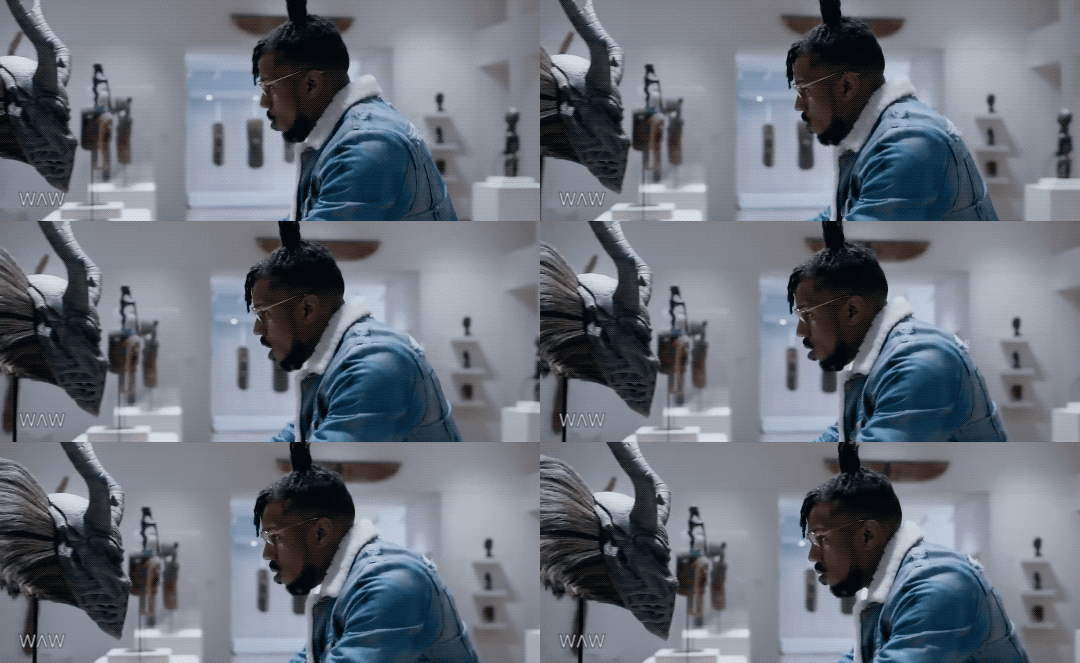
Why museum professionals need to talk about Black Panther

eamesinreallife:

kaijutegu:

friendly-neighborhood-patriarch:

knightoflodis:

friendly-neighborhood-patriarch:

kaijutegu:

heres-lou:

kaijutegu:

nativenews:

wearewakanda:

image

Museum Guide: These items are not for sale.

Killmonger: How do you think your ancestors got these? You think they paid a full price for it? Or did they take them like they took everything else?

I work in a museum- an old one- and during this scene I was nudging my brother the whole time. I clapped a little at that line. Museums need to rethink the way we curate things. If we aren’t elevating the heritage of those objects’ creators, if we aren’t telling their story, if we aren’t making those narratives accessible to the descendants and letting them lead, then what is even the point? Decolonize collections. Practice co-curation. Hire scholars of color, and make the collections accessible to visiting scholars. Involve the descendant community and elevate their voices, not the white colonial narrative.

And for goodness’ sakes, don’t run your museum like a jewellery shop. Have context. Honor the objects for their beauty, but remember that no object is as important as the people who created it.

Ummmm,, and like straight up, give things back? Indigenous communities in North America have campaigned for decades to have body parts, ceremonial items and sacred parts of our history returned to their communities.

Ofcourse, Hurd scholars of colour and think critically about your role. But like sometimes, you just have to give things back.

That’s repatriation (what I meant by “decolonize collections”) and it’s actually been federal law in America for almost thirty years. It’s been happening and will continue to happen, but it’s a LOT more complicated than just “give the stuff back.” Obviously you’re totally right- giving the stuff back is absolutely necessary. 

But at the same time, giving ALL the old stuff back to Native groups doesn’t really work, either- for us OR for them. What happens to the stuff when it goes back? Do the modern Alaskan Athabascans really want the 1000+ baskets the museum I work at holds? (No, they don’t. We asked them. They definitely do not want those baskets back.) What about Native groups who don’t want remains back- the Navajo, for instance, believe that the remains of the dead are taboo objects, unclean and best left buried. And there are some Native groups who actually WANT their objects in museums. Not every object has a ritual context- sometimes a pot is just a pot. Even some ritual objects aren’t as spiritually important, and we’ve actually had people from different tribes come in and help rewrite language surrounding an object, or give instructions as to how it should be stored. Some groups really want us to display their cultural artifacts, because it reminds people that Native American cultures are alive and real. 

One thing that works really well in a lot of cases is co-curation, which is when we commission and work with Native artists, leaders, and scholars to reframe the way we display objects. Like, recently, we asked Chris Pappan, who’s a Kanza artist, to come in and draw on the displays from the ‘30s. The juxtaposition of his art with the colonialist view of Native Americans has had a huge impact in visitor impressions- people go to that gallery now to learn and see what’s ACTUALLY happening today with Native Americans. This I think is how these institutions can use their power for good- elevating creator voices and letting them present their own past and own history. The Field does that a lot- we’ve had exhibitions from Rhonda Holy Bear, Bunky Echo-Hawk, and are continuing to work with Native Americans from many tribes to redesign and reframe the objects on display. We’re not doing this for social justice points- we’re doing this because the Field Museum gets something like 1.5+million visitors a year, and we owe it to the Native tribes we stole from to a.) tell their story b.) how they want it

If you take all evidence of Native Americans out of the big natural history museums, you’re taking away representation- and education- and a lot of tribes actually don’t want that. What many groups want is the old colonial narratives to go away and be replaced with their own messaging and history. Native Americans are mythologized and what we did to them is sanitized in the US education system. I know that the person who responded is in Canada- and from what I hear, they’re even worse about destroying Native history and sanitizing what the colonists did (and continue to do) to them and their cultures. And this is where I think museums can actually HELP. People only care about things they’re familiar with. If the only image you have of a Native American is a racist football mascot, you’re not going to care about them as a culture- you’re not even going to see them as people. There’s a lot of white people who don’t believe in Native Americans. Like, they legit don’t think that there’s ANY Native groups left, and I know this because I’ve talked to these people at work. It’s baffling, how little Americans know about their own country’s behavior. And it’s totally a global problem- I could go on for days about what the British Museum Needs To Do With Those Fucking Marbles, Give Them Back You Cowards, You Have Enough Money To Ensure Their Care In Greece You’re Just Being Assholes- but I wanted to respond with a Native American context because of the person I’m replying to AND because… well, most Americans don’t know this, and they need to, because knowing about repatriation and why we do it is important. 

Repatriation is so very vital, but it’s even more vital to listen to the Native American groups and ask them what they want to happen- as well as treat each tribe individually. We don’t hold onto Tlingit remains because the Navajo don’t want their remains back. Treating all tribes as identical is wrong- not as wrong as withholding their precious cultural traditions, relics, and remains- but if we’re even going to (as a museum industry) attempt to apologize for the atrocities we’ve sanctioned, the first thing we gotta do is ask people what they want

And the next thing we gotta do is listen.

Skeptical. Very much so.

Skeptical? What’s skeptical? I am confused

About repatriation until the countries can show they can take care of the objects. I don’t like retroactively looting museums for the sake of correctness. Something doesn’t sit right with me.

Further, Palmyra and the Iraqi national museum comes to mind.

I don’t know. My opinions are developing on the issue.

Ahh, gotcha. Yeah, that’s certainly another issue! With Native American repatriation, the objects and remains repatriated often aren’t conserved at all- they go back into use, or in the case of remains, they’re given a burial.

But sometimes it isn’t safe! Sometimes it’s dangerous for artifacts to go back- they might get damaged (see: Iraq) or they’re so fragile that they can’t travel, or the home country can’t support them. In these cases, you can still make these objects available to the descendants- through outreach, digital resources, reproductions, and on-site work. This is super important for African art in particular- in a lot of cases, sending it back isn’t helpful, because of the way Africa got split up- if an artifact is from a group that straddles a country line, who gets it? And what if sending it back means that now diasporic descendants (who never got the chance to know exactly from who they came from) don’t get to access it? Africa is so salient for this because of the slave trade- for a lot of people of African descent, western museums are the main way they get to see the actual things their ancestors made. They live in these countries, like the US, where their history and contributions are so frequently ignored, and don’t they have the right to connect to their heritage through artifacts, too? Giving everything back would be hugely detrimental- and again, people only care about what they see.

Which is where consulting these communities comes into play. In black panther, the artifacts have no context. They say nothing about African life! They say nothing about what it means to be African, or from a specific African nation/tribe! They’re treated like trophies, and that’s bad display. I think that one of the most important goals of modern museums is education- what can these objects tell us the public, along with the cultural descendants of the creators? In many cases, repatriation isn’t the right answer- but that can’t be decided without a conversation between museums and descent groups. A good-faith convo, not one where the museum flexes its financial/cultural power, but a conversation where the desires of the people and the reality of conservation are both discussed.

And even in cases where repatriation isn’t a feasible option, co curation is almost always a possibility. You’d be surprised how many groups will happily enter into dialogue with museums who hold their cultural heritage, so long as there’s a real effort to include their voices and opinions.

It’s not a question with a simple answer. Museums have to live with the legacy of their creation as a product of colonialism, and they have to use that responsibility in a way that provides actual benefits to the people affected.

All of this, and libraries and archives too.

Why museum professionals need to talk about Black Panther