So I will admit I was feeling funny about going to the Field Museum because of the whole “look at display of objects from colonized groups” thing. Especially because of the Black Panther post with commentary on museums.
But boy, the Field Museum really does seem to be doing a fair amount towards rectifying past attitudes and actions. I took these two pictures and there were at least two others I wish I had remembered to take pictures of. I was thrilled to see such obvious mentions of this kind of thing instead of a lack of change or pretending it didn’t happen.
@kaijutegu I’ve been meaning to post these for the past few days, every time I see the BP museum post go by again!
This is great, but I would be really curious to see what tribe responses to these efforts have been. I know a lot of tribes struggle with NAGPRA recognition and have to be “validated” through historical records written mostly by white explorers. I would hope the Field Museum would take a more proactive approach. I also hope there’s an effort to return these artifacts to their homes and help those populations with preservation on their own terms, rather than maintaining those items in their own care (unless that permission has been specifically granted).
@upperpaleolithic Idk if you already did, but in case you didn’t, I would click to read the Black Panther post I linked! I know @kaijutegu talks a lot about returning artifacts to the groups they came from & such, and co-curation (which is the maintaining of objects at the museum, but with input from the original group).
I don’t think it’s in the link I included, but I also remember another discussion on that same post where people were talking about how there are still issues with paperwork & bureaucracy & difficulties with recognition or jumping through hoops to sort this kind of thing out. I think it was more about the availability of collections to scholars of color & scholars from the groups that those collections are from, but yeah. Still definitely some difficulties, and I’m sure not all museums have the funds or time or people necessary to be doing as much as they should with de-colonizing and all. But there is some progress and hopefully that will continue to spread and improve.
Loads of good stuff to talk about here! ’s gonna get long, but I hope you take the time to read it if you’re interested in this stuff! Also please let me know if you can’t see the links.
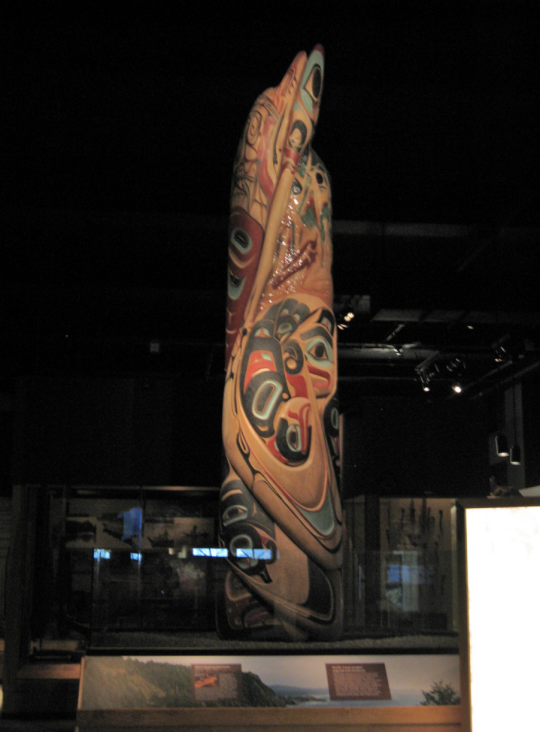
I’ve posted about it before, but the Field has an incredibly good repatriation department that actively does work with indigenous nations to get stuff home. But the goal isn’t “empty the museum,” the goal is “present indigenous history in a way that represents what the native group actually wants.” Case in point: this totem pole.
I told the story of it here, but the gist is there was this really awesome but totally stolen totem pole and the people who made it rather wanted it back, so back it went- but then the museum commissioned a couple of native artisans from that same group to create a new totem pole to take its place. When done well, repatriation’s not just about giving stuff back- it’s about building relationships with the groups. A lot of Native American groups want archaeology and museum exhibitions to happen- they recognize the scientific and social value. But they also generally don’t want to be objectified.
Another really good example of culture of origin reaction to repatriation/co-curation is the Maori response to the Field’s marae, or meeting house. The house was sold in the midst of a family dispute, and another one was constructed at the original site- and when the Field wanted to exhibit the house, their first point of contact was that family. One of the curators had been trying to talk to the descendants for years about the possibility of repatriation, but… ok, so this is another kinda sticky point about repatriation.
Not every object was stolen and/or excavated; some were actually sold- and there can be an enormous deal of shame surrounding past actions, which was the situation with the descent group for this marae. The fact that the museum bought is inconsequential to this shame- the shame here comes from the fact that it had been sold at all. A family elder/chief had sold it, and that was still a major source of family shame- like somebody selling Grandma’s headstone. When the museum tried to reach out to them, for quite some time it was like rubbing salt in this still-present wound. To the Maori, these houses are alive- spirits dwell in them- and they still have incredible spiritual significance to the Maori today, and so what the museum and the Maori ended up doing was… honestly, something really spectacular.
No, really, it’s cool as hell. The original creators’ direct descendants were flown other and stayed in Chicago for a while while they talked with the Field curators about what to do with the marae. It was restored and painted- not the standard methods for archaeological conservation, but that was less important than keeping the house the way the Maori wanted it. Maori groups regularly come in and have events there, and we do what we can to help keep the spirits warm. Sometimes people even sleep in there, because the Maori asked for that. Now, the big repatriation law in the US- NAGPRA (the Native American Graves Protection and Repatriation Act)- doesn’t cover non-Native North American groups, but this is something that the Field finds important for a lot of reasons. It’s not just about ethics- it improves the museum experience for guests as well. It adds context and shows cultural continuity for the creator cultures.
The Field also has co-curation in place pre-NAGPRA; the Pawnee Earth Lodge we have is a modern recreation that was built with the guidance of Pawnee elders back in 1977. It’s been rededicated, and there’s been drum circles and purification rituals held there by representatives of the Pawnee nation to cleanse the space. It would have been ethically tenuous to have a “genuine” earth lodge in the museum, but having one built for us that combines ancestral and modern Pawnee spiritualities and sensibilities is like I mentioned in the other post- it’s a way to show museum guests that Native Americans still exist and that these rich cultures and their traditions aren’t some relic of an ancient past.
But there’s a major design flaw in NAGPRA that makes repatriation extremely difficult sometimes, even when the museum itself wants to give stuff back. This barrier is the five year rule- basically, when NAGPRA was passed in 1990, museums had five years to identify all of the Native American stuff in their collections and list its tribal affiliation. In the bad old days of collecting, a lot of people didn’t bother to take down the names of the folks they took stuff from, and thanks to the way the US laws regarding tribal enrollment work, group affiliation can change, be subsumed into larger groups, or just not be federally recognized. So a lot of material got classified as “culturally unidentified,” and some museums aren’t making efforts to identify it. And legally, they don’t have to, because they were supposed to get that done within that five year period. Five years is a tiny amount of time to get a bulletproof cultural affiliation on artifacts and remains- big natural history museums have millions of objects in their collections sometimes.
Now, I can say with absolute certainty that the Field is not doing that, because I’ve actually worked on some of this material. A few years back, I was working on a project to identify several hundred boxes of that “culturally unidentified” stuff. These boxes were considered lowest priority because they only contained soil samples, rocks, animal bone, some lithic debitage, and ceramic potsherds, but the work still was important. When my chunk of the project was complete, our repatriation department sent notice to several of their native contacts. None of them wanted two hundred boxes of broken pottery back. Case closed- unless later on they decide they do want it, in which case now it’s been identified and so they’ll get it pretty quickly. That’s an example of a best-case scenario. When remains are involved, it gets a lot trickier. Sometimes two or more nations claim the same set of remains, or the museum drags its feet. Harvard’s Peabody Museum runs into this problem a lot- here’s an article from a few years back, if you want some scope on this kind of problem. If the Wampanoag and the Narragansett clam the same remains, and their historical territorial affiliations overlap, and DNA testing isn’t going to give a good outcome (some groups do not want DNA testing, and others are so closely related that haplogroup testing wouldn’t really be helpful at all, plus admixture over the years can make DNA testing even more complex), who’s in the right? Who gets the remains? Sometimes it works out- Kennewick Man, for instance, ended up buried in a location agreed upon by the groups that had claim to him, and most, if not all, of them participated in the interment ceremony. But other times, it doesn’t- and the legal battles wage on, which can get real expensive real quick for the native groups and museums, especially smaller museums that don’t have a big endowment. Fortunately, there are federal grants available to help. But this leads to another massive problem with NAGPRA…
NAGPRA has some serious budget issues.
Do you know who’s in charge of NAGPRA? It’s the National Park Service! You know, the one that our current president is decimating? This means that NAGPRA grants (aka money to be given to people trying to get their stuff back or money given to museums to help ID stuff) have been substantially reduced as well. In fact, they’ve been 100% reduced! That’s right, our wizened yam of a president requested a whopping ZERO DOLLARS for repatriation grants! It does seem like they did get some funding, as they haven’t closed down grant application- but I hope this stands as an illustration of the potential seriouness of this problem. In addition, part of the legal requirement for repatriation is publishing inventory completions and intents to repatriate in the Federal Register, and there’s a massive backlog of those.
Finally, the actual repatriation process does take some time. The NMAI has a really cool guide to safe repatriation online here; you really can’t just hand over the stuff and say “see ya! you’re on your own!” A lot of it’s actually poisonous, thanks to the old-timey pest treatment called “covering it in arsenic until the bugs are dead.”
OTW Legal and our allies have been active in fighting on fan-unfriendly legal proposals in the EU. Since these proposals were introduced in 2016, OTW Legal has submitted comments opposing them and has joined in calls for action against them. We’ve managed to hold them off so far and encourage some revisions, but a key vote will be happening in the European Parliament’s JURI committee on 20/21 June that could have a significant impact on the Internet and fan sites. In particular, two provisions of the current proposal would be bad for fans. Article 11 would impose a “link tax” that would make it more expensive for many websites to operate, and Article 13 would impose mandatory content-filtering requirements on websites that host user-generated content. These provisions have been hotly debated and revised a bit since the last time we reported on them. (For more on recent revisions and debates, see these discussions by the Electronic Frontier Foundation and the Hogan Lovells Firm) But despite revisions, they’re still bad deals for fans. Importantly, they don’t preserve the “safe harbors” that websites rely on to operate, and they don’t include user-generated content exceptions.
Without safeguards for user-generated content, Article 13 would require your favourite websites to implement systems that monitor user-generated content and automatically remove any content that could potentially infringe upon copyright, giving publishing giants the power to block your online expression. Sites like YouTube, Tumblr, GitHub, Soundcloud, etc., could be required to block the upload of content based on whether it has been “identified” by big corporations, rather than based on its legality. The law is still being debated, and it is difficult to predict how it would impact the OTW’s projects, including the Archive of Our Own, if it is passed. Regardless of how this vote comes out, the OTW will work as hard as we can to keep the Internet fan-friendly. But we need your help. The most effective thing you can do right now is contact your Member of European Parliament. You can use one of these tools to e-mail your MEP or call your MEP to tell them that having user-generated content on the internet is important to you.
Here’s what you can tell them: Without safe harbors for user-generated content, Article 13 of the Copyright Directive would stifle free expression on the Internet. We don’t want mandatory filtering. Algorithms don’t understand limitations and exceptions to copyright like parody, public interest exceptions, fair use, or fair dealing, and we don’t want our non-infringing videos, website posts and art blocked because of a biased algorithm created by big corporations. We want the law to protect user-generated works, not harm them.
OTW Legal will keep fighting for fan-friendly laws!
Please signal boost if you can’t help directly!
If any of my followers are in Europe, please help protect the AO3 (and other fannish archives as well)!
@lavvyan based on a past post I think of you as the in-house expert. Does it check out?
I wanna know the answer to the above.
This is actually the very issue I posted about. It’s hella important because while Article 11 is mostly about money-grabbing from Google, Article 13 in particular leaves next to no room for content that is based on existing, copyrighted media. Any big content provider would have to install automatic filters, and those are likely to err on the side of caution. Which means that anything that smacks even faintly of copyright violation would never see the light of day, fair use or not.
If you click the link to the AO3 post, you can scroll down to find their links to the tools you can use to contact your representatives in the European Parliament. You won’t even have to come up with a text of your own, though I recommend translating the provided text into your native language to be taken more seriously. It might also help if you put in an e-mail address that’s visibly from your own country, like web.de or whatever, instead of the generic gmail.com.
I say again, this is important. There’s so much ridiculous information going around on Tumblr, the worst of it being that right-wing pro-Russian nonsense, and the whole issue is slipping under the radar. If you’re an EU citizen, please, please contact your MEPs.
Don’t put this on your to-do list or your check-out-later list. The vote is in ten days. E-mail them now or live with the consequences. I’m not even joking; media coverage has been non-existant and if Tumblr, AO3, YouTube and everything else does end up impacted negatively when you could have said something, I’m going to blame you for not doing anything. The e-mail text is provided. You put in your country and it automatically selects all your MEPs. As spoons go, this is a small one.
The Supreme Court just issues a ruling allowing Ohio and other states to purge voters from their election registration rolls due to their failure to cast a ballot in previous elections.
This is a major victory for the Trump administration and the GOP, and a direct consequence of the Supreme Court being stacked with more conservative judges (the votes were 5-4). This is also a huge part of what Trump/the GOP were counting on to save them in the 2018 midterm elections, which is where Democrats have been hoping to take back a majority in the House, giving them more power to combat Trump’s abuses of power and Republican legislation.
What this means is YOU CAN NOT ASSUME THAT YOU ARE REGISTERED for the 2018 elections, just because you SHOULD be. Thanks to this decision, red states can purge voters’ registration based on their not having cast a ballot in even just previous federal elections, NOT just the national Presidential elections. Effectively, if you haven’t voted in previous senate races or for congressional representatives in the past few years, that’s all they need now to say you’re no longer registered and need to register again.
They’re deliberately counting on people assuming they’re still registered and so not checking until after registration deadlines have passed, or showing up to vote this November and only then finding out they’re no longer registered, when its too late to do a damn thing about it.
And this is absolutely targeted at marginalized communities, low income voters, disabled voters, and basically anyone who simply can’t always AFFORD to keep on top of every federal election and show up to vote in every senate race, etc. Which not so coincidentally happen to be all the communities and voters who have the most to gain from Democratic victories in the 2018 midterms and are the least likely to cast votes for GOP candidates at this point.
This was absolutely a calculated effort aimed specifically at keeping the GOP in power with a majority control of the government come November, and unfortunately, it has a DAMN good chance of accomplishing just that if it goes by unacknowledged. I’m not looking to alarm or panic anyone, simply to say:
If you are a registered voter in a red state at this point, please please please do not take your registered status as assumed. Check on your registration status, look up all relevant voter registration deadlines for your state and district, CIRCLE THAT SHIT ON YOUR CALENDAR, and check your registration status AGAIN right before those deadlines pass, so you can be sure of it before its too late to do anything about it til the next voting cycle.
use vote.org to check your registration status. use the form, or scroll down to find the resources for the state you live in.
please do check! even if you think you are OK. even if you are not in Ohio. and please be aware of your state’s voter ID laws.
I am a poll worker in Pennsylvania, and if you haven’t voted in a certain period of time you do get asked for ID. I don’t like it but that’s the rule.
I’m guatemalan, and yesterday it occured a terrible disaster. El Volcán de Fuego erupted, killing more than 30 people, more than 100 injured and more than a million people affected. People is still disappear, everyone is in great need. Please, if you have the oportunity to help, we need:
– Medicine (there are a lot of burned people)
– Food (beans, rice,clean water, canned food)
– Clothes
– Cleaning products
Guatemalan embassies are open in some countries to recive help. I will leave links in the description.
Since on tumblr it’s impossible to tell when anything was posted, just for context: the volcano erupted on June 3rd, 2018. This is very recent, and the disaster is still very much ongoing. The volcano isn’t even finished erupting, there’s still smaller eruptions ongoing. The only reason the death toll is hovering in the double digits for now is because several villages have been completely buried or rescue workers are cut off by lava, so they can’t get to the worst area’s to confirm deaths. This is horrifying. Please donate.
“Ballet embraces the soft, ethereal and majestic side to women, and yet we often don’t see the media portray black women in this light. My project aims to reveal that women of color possess these qualities. We too are capable of portraying the princess, fairy and swan.”
—Aesha Ash
Aesha Ash’s prestigious career has included world class roles. Yet she’s now on to a different mission, with three big goals. She wishes to see ballet become more diverse. She hopes to inspire youth from rough areas to pursue their dreams. And she wants to show the world that tough environments can’t hold back talented people, especially those with ambition.
Aesha performed professionally for 13 years. She attended the legendary School of American Ballet; joined the New York City Ballet at age 18; and has danced solo and principal roles for companies like the Béjart Ballet in Lausanne, Switzerland, and the Alonzo King Lines Ballet in San Francisco. Now she’s focused on The Swan Dreams Project, in which she uses imagery to tackle stereotypes placed on black women. Aesha commissions photographers to snap her as a ballerina in her hometown of rugged Rochester, New York, and in Richmond, California, and then donates proceeds from photo sales to organizations helping advance inner city youth. She also donates images to organizations for their fundraisers and to people seeking more positive imagery for their children or groups.
The dancer points out that black women have always existed in ballet, yet few become principals, the highest tier of dancers. When Misty Copeland became the first black female principal with the prestigious American Ballet Theatre last summer, Aesha found the milestone a moment to celebrate, yet sad and troubling that in 2016, we’re still celebrating a first. She hopes The Swan Dreams project will give more dancers — and youths in general — the chance to be celebrated for their own talents.
Rochester has one of America’s highest crime rates. But Aesha hits the streets to prove that her hometown is more than violence and gangs. That’s where her Swan Dreams Project comes in. “My community saw that out of our environment came a ballerina, not just negativity — a little black girl from inner city Rochester actually went on to become a professional ballet dancer in a top-tiered company,” Aesha said in a one-on-one interview for this report. “Youth followed me on the street saying, ‘This is what we need. This lifts us up.’”
Since I haven’t seen any mention of it yet, except on twitter, i’d also like to remind everyone that not only is June LGBT pride month, but it’s also Indigenous History month!
Please take the time to support, uplift and remember your Native, First Nations, Aboriginal and otherwise Indigenous friends and family. We are here, we exist! We have a long and winding history that deserves to be heard and respected! The word ‘Indigenous’ is so wonderful, and so expansive, and includes so many different cultures under its arms. Go out, learn about our histories and our cultures. Talk to the Indigenous people around you! We’re everywhere!
And not only that, but also be sure to give extra support to LGBT indigenous voices in this community. We are a minority that is scarcely acknowledged, and in desperate need of it. Too many times have I gotten strange looks for being so openly Native and so openly a lesbian. It’s as if that combination is impossible for people to understand. Support our content, buy from our stores! Or at least just include us!
I’d like to wish a happy LGBT pride month, and a happy Indigenous History month to everyone, but especially us LGBT Native folks. This really is our month to be open about ourselves, and I sure intend to. 💗🏳️🌈
Hope this will spread as much as save net neutrality posts
it’s way worse than that law actually, in US they “just” wanted your money, here the EU goverment wants to take our freedom without even giving a choice
SPREAD THIS
I’m just speechless. Dudes, this is wayyyy worse then The Net Neutrality bullshit in the US. Spread this like a wildfire! I don’t wanna lose everything I have thanks to this law!
Oh my gosh why am I only hearing about this now? Please everyone, spread this! Most of the time we talk about problems that are happening in the US but this time it’s in the EU and we need to stand against it!!
Please help if you can it’s going to make so much damage! Just for an example, both of my blogs will disappear if it isn’t stopped, ao3 will also disappear for european countries just like every website like these ones.
So please, help!!
WTF
If you’re interested in learning about it, you can google Article 13.
People who don’t understand how the internet works are trying to regulate it. And strangling a whole lot in the process.
Thousands of kids were exposed to lead and more toxins in our water. It is so bad I can’t even use a slip n slide or take a bubble bath like a regular carefree kid.
so this has been bouncing around my head for a while and I’m still not sure if this is the best way to phrase it, but…
making opportunities for everyone to explore their gender and orientation means nothing if it’s not safe for people to be wrong about their gender and orientation. otherwise, “exploring your identity” becomes limited to “confirming what you were already pretty sure of,” which isn’t going to do anything for anyone who isn’t already at that stage.
like, time and again i’ve seen people questioning whether they’re allowed to use certain pronouns or labels if they’re still questioning those identities or if they need to wait until they’re more sure of the label. or people being worried that changes in how they identify and the language they use to describe themselves will validate stereotypes.
and this is the result of a culture where choosing an identity label that ends up being wrong is far worse than never exploring your identity in the first place. it’s the same reason people freak out about trans kids, because what if they decide they aren’t trans after all in the future? it’s also why i’ve run into multiple callouts on this site that include things like “10 years ago they called themself a ‘lesbian with an exception’ for a couple of months,” because trying to reconcile old identities with new experiences is seen as a threat.
and in the end, the people this attitude ends up punishing are folks who are targeted by cissexism and/or heterosexism, but are lacking some of the language or the experiences or even the community that would allow them to express how those systems impact them.
If anyone reading this has ever argued with me about trans issues at all, you need to read this and you need to learn it. You don’t gatekeep. You don’t police. Because when you do, you hurt people trying to figure themselves out, regardless of your intent or how careful you try to be.
If you create a space where it’s safe for people to be right but not wrong, you’re not creating a safe space, you’re just creating a judgmental one.



 Site Title