Natalie Portman being confused by the fact that you have to say “hi” to someone before starting a conversation in France got me like ?????
“I feel there’s a lot of rules of politeness and codes of behavior there you have to follow. […] A friend of mine taught me that when you go in some place you have to say “bonjour” before you say anything else, then you have to wait two seconds before you say something else. So if you go into a store you can’t be like “do you have this in another size,” or they’ll think you’re super rude and then they’ll be rude to you.” [X]
So that’s it guys. French are not rude, we just don’t like it when people don’t say “Hello” or “Hi” when they start a conversation.
Don’t everyone say “Hi” before they ask something to someone? What’s next? Saying please is also a french thing or others countries does that too?
Canada is similar. We say sorry and please. The Hello thing seems strange, but it actually makes sense.
Bro, this threw me for a loop when I moved up north. Like in the southern United States you say “Hi, how are you?” And then make a few seconds of small talk before you ask your question or order your food and when I went to Connecticut they were like “What do you want?” Without any hello or anything. In other places they just STARE at you waiting on you to place your order and gtfo.
I laid my hand over my chest the first time, and the only way to describe my look was “aghast” before I said “Good lord!” My husband said it’s the most southern thing he’s seen me do. He thought it was hilarious. But…. Like??? That’s rude as fuck??????? Don’t y’all say say “Hello” before throwing your demands at someone??
maybe this is why everyone thinks new yorkers are rude
this is absolutely why ppl think new englanders r rude. no one has any fucking manners
african culture, at least in ghana, demands you greet a person before you ask them something. if youre in an open market they may even ignore you if you dont.
We do this in Australia as well. If you just started straight off saying “yeah I want XXXX” we’d think you’re rude as all fuck. You say hi, then make your request. It’s basic acknowledgement of the other person as a person rather than some random request-filling machine.
Huh. Speaking as a New Englander, I usually go with “Excuse me,” but sometimes “hi” or “hey,” but with no pause – it’ll be, “Excuse me, hi, I was looking for X?” From my POV, it seems rude to get too chatty and waste some stranger’s time; I assume they have better things to do than make small talk with me, so I just get my request out there so they can answer me and get back to whatever needs doing. I always thank folks for their help afterwards, if that helps?
(The rules of etiquette are strange. People say New Englanders are rude and cold, but once during an unexpected snowstorm here in Seattle, my car got stuck and I was standing by the side of the road at a busy intersection in the snow for half an hour waiting for my housemate to come pick me up, and not a single person stopped. Back in Massachusetts, every other car on the road would’ve been pulling up to check to see if I was okay, if my phone was working, did I need a lift, etc.)
No but this was the first thing my cousin told me in France? you never ever ever start a conversation with anyone, not even like “Nice weather today, huh?” without saying Bonjour first. You HAVE to greet them or, just like Ghana, they’ll ignore the shit out of you, you rude little fucker
(And “excuse me” or “pardon me” doesn’t cut it. you still have to open with bonjour)
[and I can’t speak for New England but coming from Chicago and then moving Out West where the culture is VERY influenced by the South and DETERMINED to think of themselves as small town folk… I HATE when I have to make small talk before ordering food??? Like, if it’s a coffee shop that’s pretty much empty I’ll chit chat for a few seconds, but I’m still not going to make inane conversation about the weather unless the weather is extreme.
In a big city it is rude as fuck to waste my time making small talk with me when we are not even friends or neighbors??? I am here to get shit done. There are four other people in line behind me, and I don’t want to waste their time. I am here, I HAVE MY ORDER ALREADY DECIDED BY THE TIME I GET TO THE FRONT BECAUSE I AM NOT A CAVE WOMAN, and I am being polite by saying both Please and Thank You and not wasting other people’s daylight.]
I live in a small northern city, and I feel it would be rude to engage someone in more than maaaaaybe a sentence of small talk before placing my order. In addition to feeling I was wasting their time, I’d feel like I was demanding emotional labour (small-talk is emotional labour for *me*) that they weren’t being paid to give.
so bizarre. New Yorker here. Saying hi, how are you, etc before these kinds of commercial interactions is what’s rude to me – because ffs, there are people in line behind you, we have lives, move it along. It’s really just a dramatic cultural difference – but borne of a real practical necessity.
Oh my god saying ‘hi’ takes less than A SINGLE SECOND YOU ARE NOT WASTING ANYBODY’S TIME
In Spain you have to say hello to people before you talk to them even people who work in retail deserve that bare minimum courtesy hello??
Transplanted New Yorker here, and the feeling here is: people who work in retail deserve the bare minimum courtesy you would afford anyone else, which is to not waste their time. You maybe say a half-second “hi” and/or possibly “excuse me” to be sure you have their attention, then you get to the point as quickly and concisely as possible. You don’t wait to get a “hi” back, you probably don’t ask “how are you”, you definitely don’t talk about the weather. You smile and keep your tone of voice courteous-to-friendly, you say please, you thank them when you’re done, and you do. not. waste. their. time.
Except ”time” is really only shorthand for the concept: you don’t intrude on their lives more than you have to. NY is a very very crowded city which allows for very little personal space, so New Yorkers have developed a form of courtesy that involves minimizing our unavoidable intrusions on each other. Which is why we hold doors without making eye contact, and why we tend to feel that in any interaction with a stranger, it’s actively rude to do anything but get to the point immediately.
Interesting discussion of regional differences in conversational convention. But the amount of “my way is the right way; everyone else is super rude and also wrong” going on in this post is giving me hives.
Hey. Listen. "Polite” and “rude” are relative concepts. Something you were taught was rude may not be seen as rude elsewhere, and might even be the polite thing to do. Conversely, something you might have been taught was polite might be seen as rude elsewhere. Saying “no one has any manners” about a group of people whose culture and, by extension, whose conversational expectations work differently than yours is really arrogant.
In the US the thumbs up means good job or great. In France and Germany it means one, they start counting with the thumb instead of the index finger. In Greece it’s an obscene sexual gesture.
This guy I knew in college worked with the campus d/Deaf/HoH group and told a story about the dinner they had to welcome everyone in. They were trying to tell this little old lady what one of the dishes was, something casserole I forget what kind, and she was getting really flustered. Finally they figured out they were speaking to her in ASL and she was from South Africa. The ASL sign for whatever it was (spinach maybe?) in South African Sign means sex. They were offering this little old lady a sex casserole.
There’s an Italian toast ‘chin chin’, mimicking the sound of the glasses clinking together. It becomes hilarious when Japanese folks are around since in Japanese chin means penis.
As for the South, I will bet you anything that how we have conversations at the register stemmed from the homestead days when a farmer would come in to town maybe once a month and this would be the only time they’d get to talk to someone they didn’t live with. I like talking with customers! If I can get them to smile then it’s a victory and I have a better day for it. It only becomes emotional labor if they’re an outright ass or are sexually harassing me. But in the big crammed city of New York it makes sense to take the get your shit and get out approach, people have a subway to catch. Out here I had to drive myself anyway since it’s fifteen minutes to the edge of town from where I live, so what does it matter if I spend an extra minute at the register?
It’s important to be aware of the differences and ultimately there’s a degree of ‘when in Rome’ that has to happen. Someone who moves from Greece to the US is going to be startled by the amount of thumbs up but ultimately they’re going to have to adjust. Someone from the US is probably going to be shocked that telling someone they did a good job was taken as an insult and they similarly are going to have to adjust. Mom’s a damn Yankee transplant and said it was weird moving to the South and having cashiers younger than her daughter call her dear, but that’s just what we do. Sweetheart, darling, honey, sugar, they don’t have overtly romantic/sexual connotations here. As long as there’s not a leer attached to it if a guy calls me ‘sugar’ when I’m at work it doesn’t parse as a flirt because it’s not one, it parses the same as if he called me ‘miss’. But when a busload of Californians came through it took me three people to realize that ‘baby’ was not flirting, it was just California.
NOTHING is universal.
This is the biggest place I’ve ever worked so it took some getting used to, like any skill, but even being socially awkward it’s easy to tell what scripts to follow. Test the waters, if they don’t respond then okay this is a move them through kind of person, be quick and efficient and to the point, feel good when they smile at ‘last question I promise, do you want your receipt’. If they do then pull out the five small talk scripts, get a smile, feel good when they laugh at the cat small talk script.
It’s also important to note that claiming your culture’s way of doing polite right is a fantastic way to fall into some really bigoted nonsense. In Puerto Rico the personal bubble is much smaller than in the US proper, like RIGHT at your elbow close. I had a cashier who was super uncomfortable because our steward was getting in her personal space constantly and he was pissed off because he was trying to HELP her with moving orders why is she mad at him? Once I sat them down and explained the difference they both had this aw shit moment because from their own standpoints they were being polite and from the others’ standpoints they were being rude. After that they were fine, when he got a little too close she’d say ‘whoa man my bubble’ and he’d laugh and shake is head and step back.
Lots of non-white cultures have things like that, particularly since white America has serious problems with sexualizing ANY physical contact to the point we’re all touch starved. The normal speaking voice is at a higher volume or it’s more acceptable to show your emotions or gesture when you speak. None of this is WRONG, but when people star getting into ‘my culture is the only right culture’ then guess who comes out on top? It ain’t the little guy.
One of my labmates was from Poland, and she had a tendency to come off as kind of abrupt and brusk, verging on mean. In particular, when she was providing feedback on a presentation or paper she could come across as SUPER cutting. Which was not her intention! From the way she would explain it, we had a running joke in the lab, “it sounds nicer in Polish.”
And this is actually true; there are scientific articles comparing the cultural contexts for communication! It’s really neat.
So in (most parts of) America, we equate indirectness with politeness. “Excuse me, would it be possible for you to perhaps pass me that salt, if you don’t mind?” The more roundabout you are, the more we consider that a signal of social courtesy.
In Poland, not only is indirectness viewed as rudely wasting the listener’s time, but directness is viewed as communicating intimacy and friendliness. “Give me the salt.”
…It sounds nicer in Polish. 🙂
Omg I love this
The Effects of Capital, Labor, and Class on Local Etiquette Across International Boundaries
seriously though it would be an enormous help if more people understood that autistic brains/bodies (and some other conditions too) very VERY frequently don’t process sensations and emotions in normal ways and INSTEAD replace them with bodily and emotional responses that are total nonsense in an NT context
like i have chronic pain, i have an always-on headache that used to be around a 2-3 on the pain scale and is now a 6-7 most days. but periodically i find that instead of actually feeling a level of pain i can rate, i have a series of puzzling physical sensations like nausea that miraculously get better when i take painkillers and go lie down in the dark. because they were actually pain signals. pain signals that got turned into something else at some point in my body. so i have days where i feel GREAT and pumped to do stuff and then i’m like WHY AM I NOT FUNCTIONING WELL and i go lie down in the dark for a while and it gets better?? because i was actually at an 8 which is Can’t Function levels for me, but 90% of that pain was invisible to me, turned into nausea and manic energy and weird sudden mood shifts instead of “pain”.
I don’t experience normal thirst signals most of the time, either. I get cravings for ice cream and lime popsicles and watermelon instead of being thirsty. I had to learn that “i suddenly desperately want ice cream” is my body’s way of saying “put some water in this bitch”.
I also get nausea instead of hunger signals a lot of the time. nausea is one of my body’s favorite go-to signals to send, in general, so it can mean almost anything. when my stomach turns i have to go through a checklist of possibilities to figure out what i’m actually feeling. this is a big reason i eat a lot of snacks. it’s step number 3 or 4 on my “why do i feel sick” list and happens at least once a day.
and anyway this shit is important for non autistic people to know because we can’t always tell you what we’re experiencing, but also sometimes we can get really upset and overwhelmed with trying to even understand what we’re feeling. doctors especially need to know this. how can i tell you what’s wrong with my body when my body doesn’t know how to use its own language for communicating what’s wrong? when it routinely sends me a mishmash of signals that are totally useless for figuring out the problem? it’s not impossible but it requires an understanding of just how different the place i’m coming from really is. you can’t get anywhere by treating me just like an NT patient.
but most people aren’t even aware that “body signals” are a real tangible thing that can be effected and “go wrong” when your brain and body are built weirdly. literally any process in your body can be broken, that should be obvious, but people are so oblivious to the things their body does automatically that they aren’t aware they exist, and therefore don’t know they can break. it’s really important to make people aware of these functions. there are so many disabilities that happen when a hidden function breaks and it’s impossible for abled people to grasp those disabilities without comprehending that that’s an actual thing their body does for them.
1. if there’s not a source, find a source. if you can’t find one, ask the person. if they can’t find one, don’t believe it.
2. if there is a source, click it. people sincerely reblogging those ‘shocking’ posts where the source leads to a rickroll or something, and they don’t know because they never clicked it: this one is for you
3. if you’ve clicked the source, look at what it is. is it the onion? Is it the daily mash? look at the other articles on the site and look for the ‘about’. please don’t be one of those people who takes the onion seriously.
4. if you’ve clicked the source and it’s not satire, how reputable is it? bbc news is a lot more reputable than supermystichoroscopesforonly99p.com. who is saying it matters. this can be hard if you don’t know much about the site, but a bit of research can help. wikipedia is a dodgy one because whilst anyone can edit it, lots of articles are under strict surveillance and will quickly get edited back. if you see a claim on wikipedia that looks strange, refer back to point one. wikipedia sources/ cites too.
5. anecdotes are not evidence! someone going ‘one time my dog ate a can of woofers dog food and died two days later’ doesn’t suggest woofers kills dogs. the plural of anecdotes is not data. sure, when 100 people are all going ‘hey, this thing makes XYZ awful things happen?’, listen, but don’t take one person’s experiences as gospel
6. ‘idk, some news article’ is not a source. ‘I saw it in some random interview a few weeks ago’ is not a source. ‘I can’t remember’ is definitely not a source.
7. if something seems too good, bad or weird to be true, maybe it is! a two minute google search may help!
8. basically ignore the daily mail bye
9. if it’s something that would make major international news if true but you can only find one source talking about it, it’s not true
10. Check the date. Don’t be the one to freak out over a five-year-old hurricane warning.
11. If you see anyone laughing at/disregarding/demonising people who reblog to ask for a source, don’t trust that person.
12. Read the whole article! So many times a headline is completely misleading, and created only for clickbait. See that recent “Clinton doesn’t believe in free college” headline. She actually said she doesn’t believe the state should pay for free college for the wealthy.
13. Screenshots of tweets and Facebook posts aren’t sources, they’re unverifiable and usually unashamedly biased towards the writers views and agendas.
Especially when the person making the Tumblr post is also the person who all the tweets belong to. It’s amazing how many times I’ve seen “Look at the storm X is causing on Twitter!” and it’s literally the same username as the blogger…
14. If you’re curious about a claim on wikipedia, you can also always click through to the ‘Talk’ page – very commonly there’s a debate there documenting the history of the claim, objections, and counter-objections: that discussion gives you a LOT more info to base your judgement on. Sometimes there’s even a formal dispute process back there, which again, gives you some context for the claim in the article itself.
The article’s edit history can also be enlightening. That takes more effort to search through, but if nothing else, you can check to see if a claim was added two minutes or two months ago, and how actively the page is being monitored/edited. If the edit history is a ghost-town, there haven’t been a lot of critical eyes on the article, and you should proceed cautiously. Flipside, a lot of activity doesn’t necessarily mean the article is sound, but it DOES mean there’s been more opportunity for problems to have been caught and fixed, and more opportunity for substantive discussion to have appeared on the Talk page (should discussion be warranted).
Corollaries to #3: 3a. Absolutely check out the source’s “About” and other articles, but also do a quick internet search to learn about their credibility or lack thereof. For instance, while it’s pretty immediately obvious that The Sun isn’t a credible source, the layout of the Daily Mail and the Daily Mirror may make them appear vaguely credible to someone who isn’t aware that they’re both sensationalist tabloids (albeit with the former considerably more sensationalist than the latter). 3b. Here is a list of known fake news sites for your perusal. Familiarize yourselves with the names/URLs for future reference. Similarly, here is a list of potentially unreliable sources on Wikipedia (which is somewhat ironic, seeing as Wikipedia itself isn’t the most reliable of sources).
Corollaries to #11: 11a. OP may have already been sealioned to the point that their natural assumption is that you’re doing the same thing. 11b. The post’s claims may be something that it’s very easy to find a source for with a quick internet search and—especially if the post is popular and gets a lot of notes (and thus a lot of people individually asking for the source)—they may be irritated that you couldn’t take the initiative to do so yourself. This is especially true if they’ve already answered this question on their blog… so check the OP’s blog before you ask, please! All of this goes double for people who are posting something about a form of marginalization that they personally face, as it may feel to them that you’re asking them to do additional free labor to educate you. Being snarky in return isn’t the most high-minded thing to do, but we’re all only human. That said: Always, always be careful about who you trust online. (And offline!) Someone who is an asshole to someone who asks them for a source may or may not be trustworthy… but either way, it’s up to you whether that’s someone you want to spend much time around.
Corollary to #13: 13a. Screenshots from any form of media aren’t credible sources. They’re very easily falsified. This is how we can get screenshots that show a user making posts that they never actually made (someone cut and pasted the user’s icon and username over the actual OP’s) and this is how we can get screenshots that aren’t of the complete post, thus totally altering the content’s message. Try doing a reverse image search on TinEye and filter the results by Oldest. If that doesn’t yield any results, ask OP for a link. 13b. Sometimes posts are deleted and screenshots are all that are left. If OP provides you with a link that is invalid, try entering it into the WayBack Machine and see if you have any luck there. If not, don’t discount the screenshot altogether… but don’t count it as evidence in and of itself.
15. Check the notes on the post. OP or other users may have added additional relevant information… or debunked the post’s original claims altogether.
16. Reverse image search (Google, TinEye, etc.) is your friend. Really. That’s how you can learn, say, that that photo of a destroyed city isn’t actually of the city that the post purports it to be at all… and that the photo is also five years old.
18. Learn to use basic search engine modifiers. (The technical terms used may sound intimidating at first, but I promise that the actual process of using these techniques is pretty simple.) This will allow you to pinpoint the information you’re looking for much more efficiently, saving you the time and energy to fact-check other claims you run into! 😉
reblogging to share the resource but I do want to point out that the code amounts to “pinterest no pinning”. like dora the explorer’s swiper the fox… but if swiper were a middle-aged stay-at-home-mom with a smartphone. technology is truly amazing
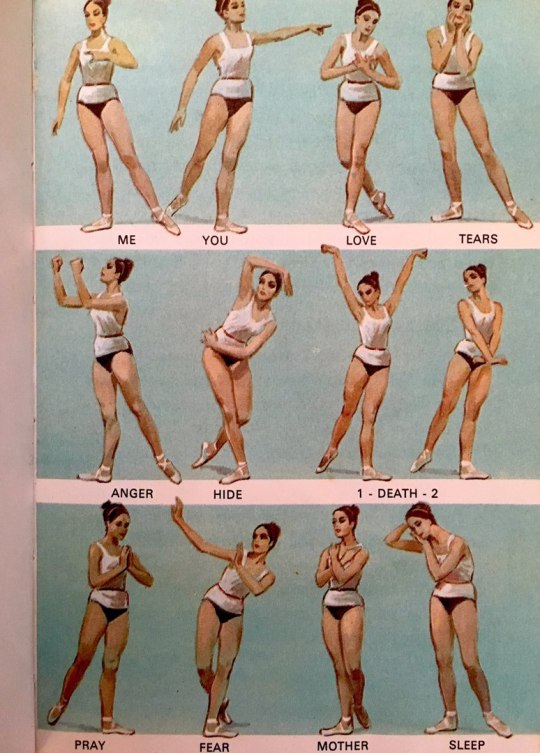
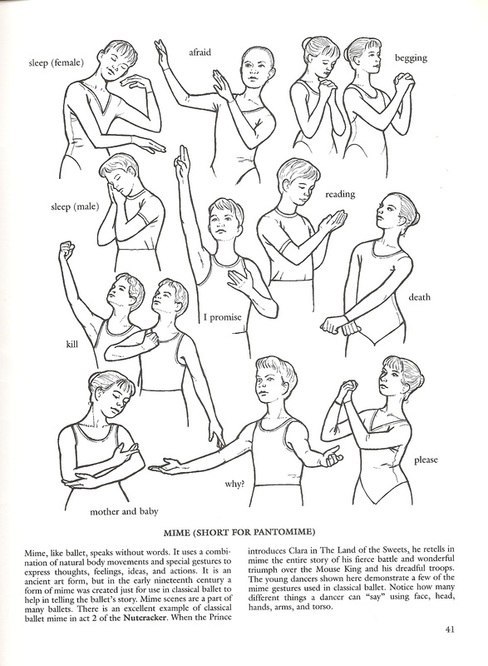
I stumbled upon this ballet mime guide the other day. It’s really neat. When I first started watching ballet, I really struggled to understand anything the dancers were “saying”. This would’ve been helpful back then.
Reblogging an old personal favourite because it is one of my most popular posts ever.
…. I really must have started ballet young because it literally never occurred to me that this wasn’t obvious. *facepalm*
Imagine the phone company throttling your calls or picking which phone calls you can receive?
“Imagine the phone company throttling your calls or picking which phone calls you can receive?“
The fastest internet in the United States is not private. It is operated as a utility. Chattanooga. The city was updating the power grid and the people working on it realized that putting in the infrastructure for high speed internet at the same time would not be that much more expensive. So that’s what they did. And a bunch of ISPs sued the city to try to stop them. Because guess what? Despite all the rhetoric in favor of the “free market”, these companies don’t actually want real competition.
So now Chattanooga has the fastest internet speeds in the entire country. It also has some of the cheapest costs in the entire country because it is run like a utility and owned by the city.
The sad part about this is that those same ISPs that sued are trying to get cities and states to pass laws to make what Chattanooga did essentially illegal.


 Site Title