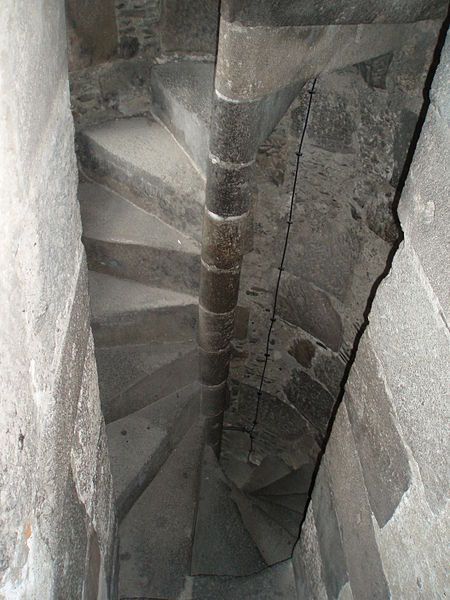
Medieval castle stairs were often built to ascend in narrow, clockwise spirals so right-handed castle defenders could use their swords more easily. This design put those on the way up at a disadvantage (unless they were left-handed). The steps were also uneven to give defenders the advantage of anticipating each step’s size while attackers tripped over them. SourceSource 2Source 3
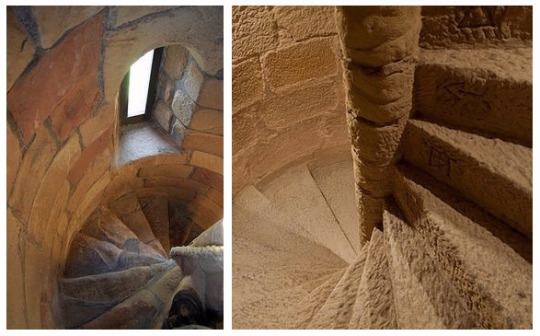
Not really the best illustration since it totally negates the effect by having a wide open space for those ascending. Castle tower staircases tended to look like this:
Extremely tight quarters, with a central supporting pillar that is very, very thoroughly in the way of your right arm.
Wider, less steep designs tend to come later once castles moved away from being fortresses to simply noble family homes with the advent of gunpowder.
Oh! Pre-gunpowder military tactics are my jam! I don’t know why, but this is one of my favorite little details about defensive fortifications, because the majority handedness of attackers isn’t usually something you think about when studying historical wars. But strategically-placed walls were used basically worldwide as a strategy to secure gates and passages against advancing attackers, because most of the world’s population is right-handed (and has been since the Stone Age).
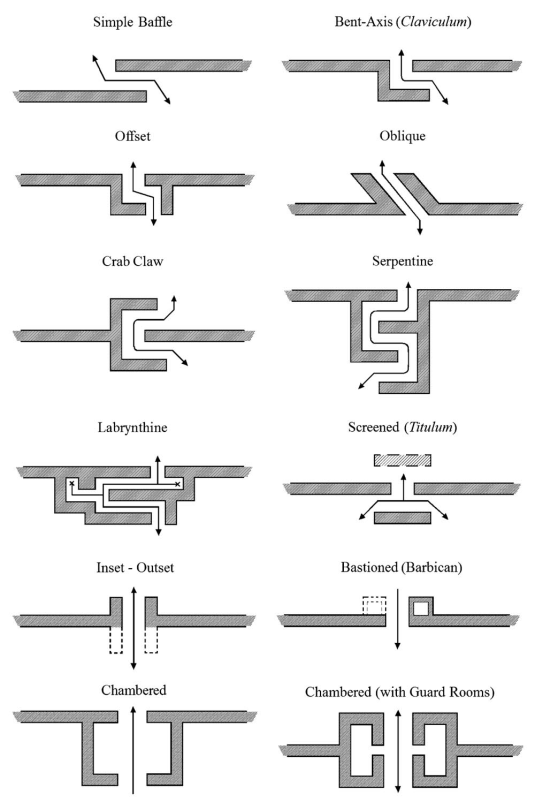
Pre-Columbian towns near the Mississippi and on the East coast did this too. They usually surrounded their towns with palisades, and they would build the entrance to the palisade wall in a zigzag – always with the wall to the right as you entered, to hinder attackers and give an advantage to the defender. Here’s some gates with some examples of what I’m talking about:
Notice that, with the exception of the last four (which are instead designed to congregate the attackers in a space so they can be picked off by archers, either in bastions or on the walls themselves) and the screened gate (which, in addition to being baffled, also forces the attackers to defend their flank) all of these gates are designed with central architectural idea that it’s really hard to kill someone with a wall in your way.
In every culture in the world, someone thought to themselves, “Hey it’s hard to swing a weapon with a wall on your right-hand side,” and then specifically built fortifications so that the attackers would always have the wall on their right. And I think that’s really neat.
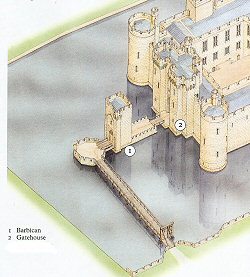
Ooh, ooh, also: Bodiam Castle in Sussex used to have a right-angled bridge so any attacking forces would be exposed to archery fire from the north-west tower on their right side (ie: sword in the right hand, shield on the useless left side):
These tactics worked so well for so long because until quite recently lefties got short shrift and had it trained (if they were lucky) or beaten out of them.
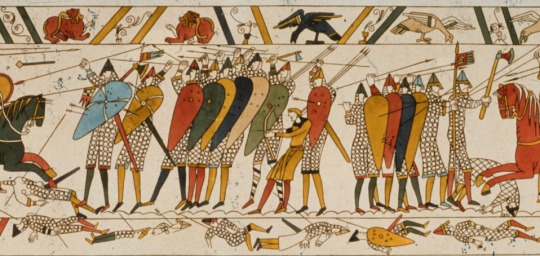
Use of sword and shield is a classic demonstration of how right-handedness predominated. There’s historical mention of left-handed swordsmen (gladiators and Vikings), and what a problem they were for their opponents, but that only applies to single combat.
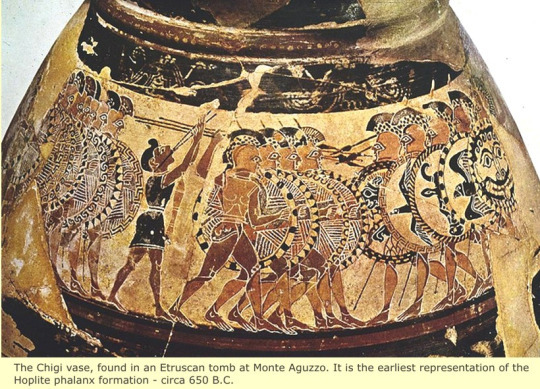
A left-handed hoplite or housecarl simply couldn’t fight as part of a phalanx or shield wall, since the shields were a mutual defence (the right side of the shield covered its owner’s left side, its left side covered the right side of his neighbour to the left, and so on down the line) and wearing one on the wrong arm threw the whole tactic out of whack.
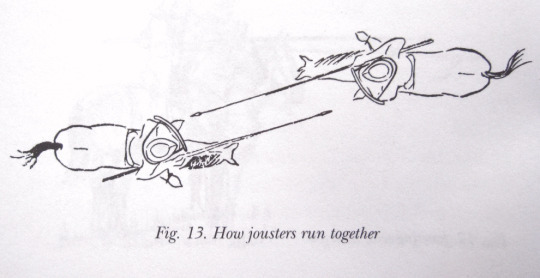
Jousting, whether with or without an Italian-style tilt barrier, was run shield-side to shield-side with the lance at a slant (except for the Scharfrennen, a highly specialised style that’s AFAIK unique.) Consequently left-handed knights were physically unable to joust.
The construction of plate armour, whether specialised tournament kit or less elaborate battle gear, is noticeably “right-handed“ – so even if a wealthy knight had his built “left-handed” it would be a waste of time and money; he would still be a square peg in a world of round holes and none of the other kids would play with him.
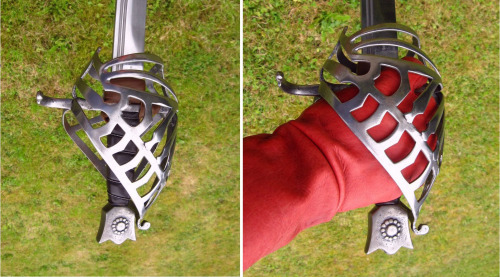
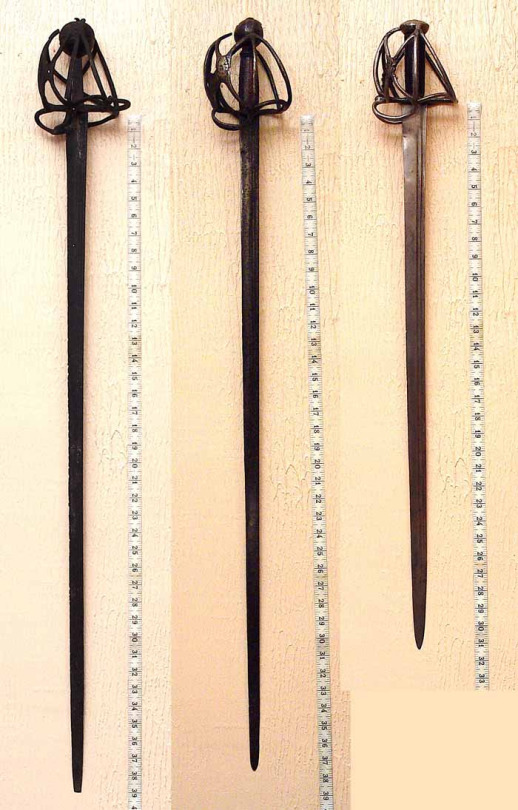
Even after shields and full armour were no longer an essential part of military equipment, right-hand use was still enforced until quite recently, and to important people as well as ordinary ones – it happened to George VI, father of the present Queen of England. Most swords with complex hilts, such as swept-hilt rapiers and some styles of basket-hilt broadsword, are assymetrical and constructed for right handers. Here’s my schiavona…
It can be held left-handed, but using it with the proper thumb-ring grip, and getting maximum protection from the basket, is right-handed only. (More here.) Some historical examples of left-hand hilts do exist, but they’re rare, and fencing masters had the same “learn to use your right hand” bias as tourney organisers, teachers and almost everyone else. Right-handers were dextrous, but left-handers were sinister, etc., etc.
However, several
predominantly left-handed
families did turn their handedness into advantage, among them the Kerrs / Carrs, a notorious Reiver family along the England-Scotland Borders, by building their fortress
staircases with a spiral the other way to the OP image.
This would seem to be a bad idea, since the attackers (coming upstairs) no longer have their right arms cramped against the centre pillar – however it worked in the Kerrs’ favour because they were used to this mirror-image of reality while nobody else was, and the defender retreating up the spiral had that pillar guarding his right side, while the attacker had to reach out around it…
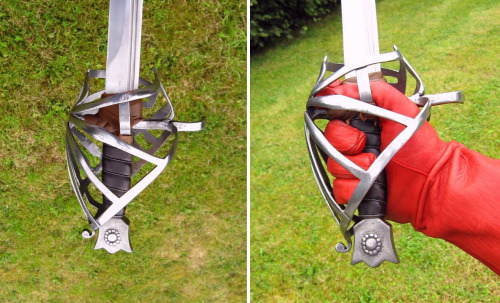
For the most part Reiver swords weren’t elaborate swept-hilt rapiers but workmanlike basket-hilts. Some from Continental Europe have the handedness of my schiavona with thumb-rings and assymmetrical baskets, but the native “British Baskethilt” is a variant of the Highland claymore* and like it seems completely symmetrical, without even a thumb-ring, which gives equal protection to whichever hand is using it.
*I’m aware there are those who insist “claymore” refers only to two-handers, however the Gaelic term claidheamh-mòr
– “big sword” –
just refers to size, not to a specific type of sword in the way “schiavona” or “karabela” or even “katana” does.
While the two-hander was the biggest sword in common use it was the claidheamh-mòr; after it dropped out of fashion and the basket-hilt became the biggest sword in common use, that became the claidheamh-mòr.
When Highlanders in the 1745 Rebellion referred to their basket-hilts as claymores, they obviously gave no thought to the confusion they would create for later compilers of catalogues…
Also, muskets had their whole “Flint and steel and gunpowder” thing on the right side so if you tried firing it lefty you’d get a face full of fire. More recently, rifles eject their spent shell casings to the right, so if you’re a lefty you get some hot metal in your eye.
in hand-to-hand combat, lefties are OVERrepresented at professional levels (mixed martial arts, boxing, etc)
this is because most people are righties, so most people practice fighting righties. When they come up against a lefty, they’re not gonna fight as well. So everyone is fighting at their shittiest against lefties
in evolution this is called “frequency dependent selection” and it basically means that the more rare something is, the higher its fitness is
This isn’t about an application. This is about colour. You can use this information on a Mac or PC, and in any editing app: Sony Vegas, Adobe Premiere, FCPX, Hitfilm, Davinci, Avid Media Composer First (linked apps are all free)- anything. Hopefully by following along with this, you will get what you are actually doing with colour in an app and know what will happen when you make changes, instead of being limited to trial and error, which is always a part of vidding but can sometimes be frustrating.
This is the colour wheel I make in the video and you can grab that as a png, psd, or aep if that’s helpful:
This is another super useful tutorial from @limblogs! If you have never quite understood what all those freaking blending modes in photoshop were doing this is a magnificent way to learn. ❤
how have i never heard of archive.org until today.. it’s an internet library that functions just like a real one, as in you borrow the books for 2 weeks and then they are returned to the archive. you can dl pdfs as well, but you’ll lose access after the 2 week period. it’s all free tho, literally just like a real library. i was searching for a cheap copy of this serial murder book from the 90s for my thesis and i found it for free on here. there’s like.. no gimmick at all? i’m so amazed. i literally just signed up and now i’m reading a super hq scan of this book for free. i love libraries.
Calling archive.org a lending library misses like, 95% of the point of having a deep database of most of the internet that goes back like, 22+ years. If you ever get an expired link, you put it there, and you’ve got a decent chance of being able to see the vanished page, in all its iterations.
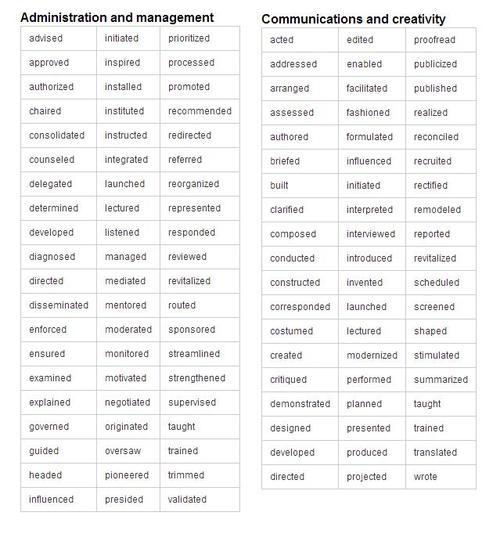
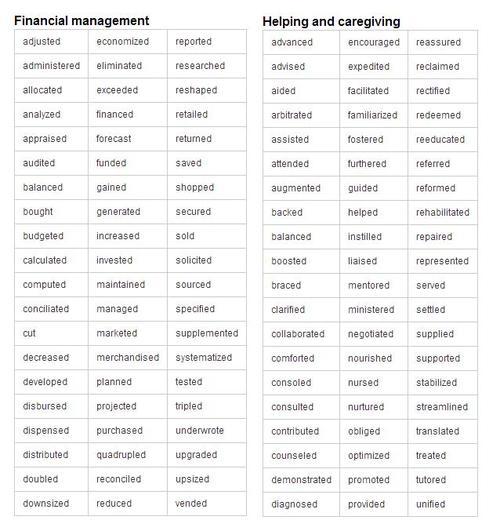
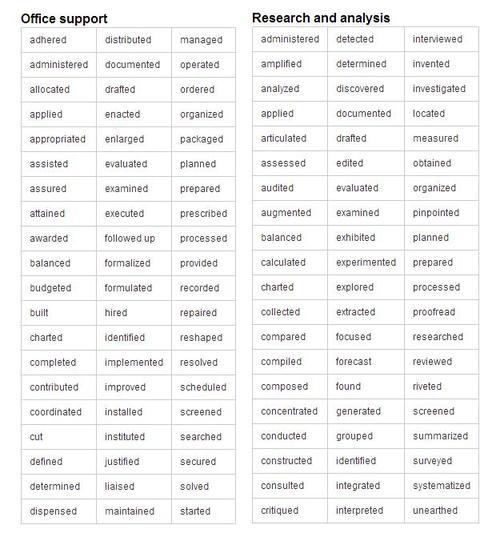
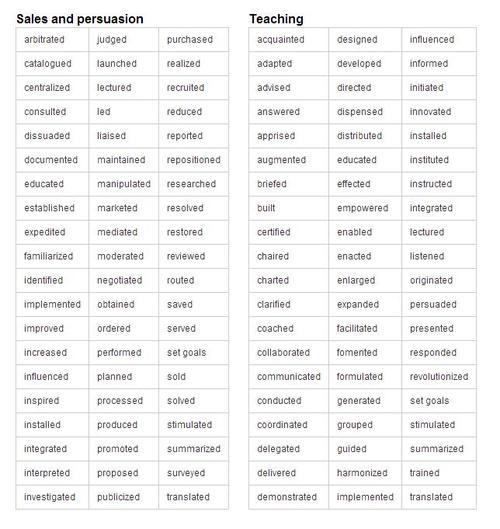
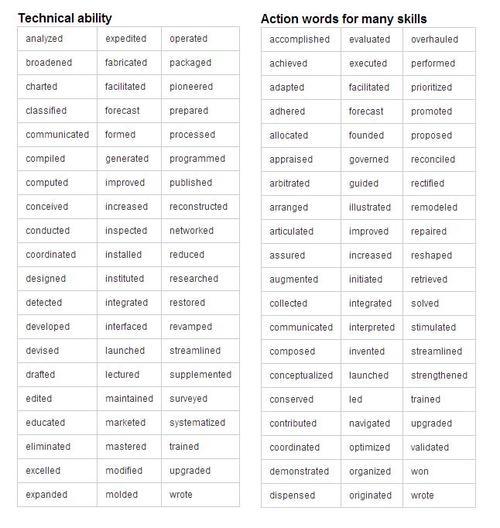
If you have ever had to write a resume for work or for an application, then you know the hardest part is figuring out what type of words to use that sound professional and and intelligent.
Example: If an application asks you if you have any relevant experience for a job at a day care center and you have experience, like you have babysat children. You would look at the words in the columns to see what words you should use that will help your resume stand out. You might put down “Have supervised and attended to children on a regular basis.”
I hope this is helpful to you.
Now this is a great resume list of action words. I love that it’s broken down by types of jobs. Saving for future use.
This is part of my webcomic Postcards in Braille, which you can read on ComicFury or Tapastic. Updates on Mondays!
This comic/guide works well enough on its own, so I thought it’d be nice to post it here as well 😀 Braille is really cool and you don’t need to be blind or visually impaired to learn it – and spreading the use of Braille can help us build a more inclusive society! everyone wins!
Bonus fun fact: Braille is originally based on Night writing (or sonography), a tactile reading/writing system created for soldiers to communicate silently at night. Louis Braille adapted it into easier to read cells, creating the Braille system. Good to know it evolved into something so useful!
– THIS – website will balance your chemistry equations and tell you what reaction type occurred – GREAT for homework!
ALGEBRA
– THIS – website will solve your algebra problems and will explain how it got the answer – it’s really good if you’re stuck on a type of problem and don’t know how to solve it!
DO YOU KNOW HOW MUCH I COULDVE USED THAT FUCKING CHEMISTRY SITE LAST YEAR
WHAT THE FUCK I JUST BARELY PASSED ALGEBRA THIS YEAR, REBLOGGING TO SAVE OTHERS.
I’M SO GLAD I FOUND THESE I’M TAKING THESE CLASSES RN LSKDFJSLDKFJJ BLESS YOUR SOUL
1. Find the closest doctor’s office to where you live. Size doesn’t really matter as long as they’re a licensed physician, but larger medical practices with multiple departments tend to have more hours than family-owned businesses. I personally love the large establishments because I can have my OBGYN and regular doctor in the same building.
2. Call said doctor’s office and find out if they accept your insurance. Have your insurance information ready (this will likely be in the form of an insurance card). Call and say something along the lines of “Hello, I’m interested in becoming a patient at this office. Can you check to see if you accept my insurance?”
3. If the doctor’s office accepts your insurance, ask for a recommendation on a doctor. I personally only feel comfortable with female doctors, but you may feel differently.
4. Ask how much money the appointment will cost you. The receptionist should be able to give you an exact amount. The price you pay will vary depending on your insurance. Check-ins are usually somewhat inexpensive. You may not need to pay anything at all, or a small co-pay. Yearly check-ins are requirements of insurance companies.
5. Ask the receptionist to make an appointment to meet with whatever doctor you have chosen. Different doctors have different hours, so you may have to be flexible. If the doctor they recommend doesn’t fit your schedule, select another.
6. Write your appointment date and time down. Doctor’s offices will typically call you the day before your appointment to confirm your attendance, but not all of them do. Some doctors require you to cancel 48 hours in advance so that they can better accommodate other patients, some will even charge you a small fee.
7. On the day of your appointment, arrive a half hour before you’re supposed to be there. This is because they’re going to have you fill out tons of paperwork. Make sure to bring your insurance card as well.
8. If you need help filling out the paperwork, ask the receptionist. Generally it’s all straightforward- your address, your emergency contact (I put my boyfriend), your medical history. Never fill out anything that you’re unsure about. You will probably also have to give consent for them to access your previous medical records (if you have any, which you probably do).
9. Doctor’s offices are notorious for running late, so you may have to sit and watch bad Sitcom reruns or a fish tank or whatever until you’re called.
10. If you at any point during your check-in feel uncomfortable with your doctor, make sure to request a different one next time. I have been very fortunate and have had great doctors throughout my whole life, all of whom have been quirky, knowledge, and down to earth. Remember- this is not your parent! You need to be honest about any drug habits you may have, even if you’re uncomfortable with it. They are bound by doctor-patient confidentially at can’t reveal any of your personal information unless they’re worried about your safety.
Great questions! I’m combining these with questions an anon asked as well, since there was some overlap!
What is it about spring and early summer that make tornadoes much more common?
This is actually a bit of a regional thing and has to do with what the limiting factor is! Think of building a tornado like building a (spinny death) cake: if you have all the ingredients on hand, you’re golden, but if you’re short on flour, you might have to wait until you have more flour on hand.
The Great Plains of the US see their peak in tornadoes around May, in large part because their limiting factor is typically moisture once it starts to warm up. Where would a big injection of moisture come from in spring? Plants! As the crops and trees green up, there’s more evapotranspiration (plant sweat), and the missing ingredient gets filled in.
Likewise, points further north green up a little later in the season, and so you see a shift in tornado season later and later in the spring or summer—in the Midwest, tornado season peaks more into early June, and in the Canadian Prairies, the peak is closer to late July.
In the fall months, there’s actually a big spike in tornado activity along the Gulf Coast and the East Coast. Why would this be? Well, tropical storms (including hurricanes!) make landfall in that area in the fall, and many of them bring embedded thunderstorms (including some tornadoes!) in their extended rainbands.
Lastly, the ingredients for tornadoes are sometimes just more or less always present in some parts of the world. Places like Alabama actually see a secondary peak in tornadic activity in the winter.
Similarly, what causes tornadoes to happen more frequently in some regions (“tornado alley”?) than in others?
Again, a lot of this is an ingredients-based approach. For storms to form, you want an unstable atmosphere. Buoyancy tells us that lighter air wants to be above heavier air—because the helium in balloons is lighter than our nitrogen-dominated atmosphere, helium (and the balloon) floats. If you wind up in a situation where lighter air is trapped beneath heavier air, that’s considered unstable, because the atmosphere will do everything it can to reverse that particular situation, and that mixing manifests in clouds and storms.
So if we want tornadoes, one component is going to be a layer of heavier air over a layer of lighter air. Now, the Great Plains of the U.S. are not level so much as they’re a gradual slope downward from the Rockies out to the east. In the Southwest, you have relatively high elevations coupled with extremely dry desert air. In the Southeast, you have relatively low elevations coupled with extremely moist air, thanks to the Gulf of Mexico. If you’re in a situation where winds out west are blowing that dry Southwestern air toward the east, it will form a layer of dry air at relatively high altitudes, reflecting the high elevation of that air. If you can simultaneously inject that really moist air at low altitudes from the Gulf, you can get a layer of moist air underneath.
Fun fact: moist air is lighter than dry air. This seems counter-intuitive, but consider that water is hydrogen and oxygen, both of which are relatively light elements. The rest of the air is primarily nitrogen, which is heavier on a molecule-by-molecule basis than water is. A parcel of air with a higher percentage of moisture (higher humidity) is going to be lighter on average than a drier parcel. So that moist Gulf air trapped under that dry Southwestern air is going to want to rise up, and like a pressure cooker, a lot of energy can be stored in the process that can then release in the form of thunderstorms, given some sort of small-scale trigger to set it off.
There are many spots in the world where you see some pretty gnarly storms forming in similar ways (South Africa, China), and they generally have that in common: a source of particularly moist air at low levels and a source of particularly dry air at high levels.
Also, if you’re caught outside and there’s a tornado, what should/shouldn’t you do?
An anon asked me for this as well as a little more information about why hiding under a highway overpass is a bad idea during a tornado.
First, here’s the overpass thing: a camera crew got caught out during a tornado and hid under an overpass. They filmed the whole thing, made it through alive, and the myth started up in earnest, perpetuated by movies (apparently Man of Steel had something like this happening?) and even some misinformed TV weathercasters.
The trouble with hiding under an overpass is that you’re completely exposed on two sides; the biggest danger from a tornado is debris (including falling hail), and it’s getting whipped around in the horizontal as well as the vertical. That camera crew could just as easily have found themselves stuck in a wind tunnel that would’ve sucked them out from hiding or bludgeoned them directly with projectiles like, well, cars.
The other issue is that when people hide under an overpass, they typically leave their cars bunched up underneath it as well. Apart from being a threat to them should it go airborne, a car in that position is difficult to spot for either other folks trying to escape the storm or emergency vehicles trying to get through; it’s very easy to cause an unavoidable pile-up with lower visibility and slicker roads.
The general best-practice if you see a tornado in the distance when you’re caught outside is to try to drive at right angles away from it (if it seems to be standing still, it may be moving directly towards you) and escape. Tornadoes often occur in areas that have gridded roads every mile, so there’s often a way out. Avoiding dirt or gravel roads is essential, as the torrential rain and hail can very quickly turn that into a mire.
If there’s no time for that or if you’re caught in a traffic jam (some extremely misinformed newscasters have started calling for people to evacuate during tornadoes, which has in the past proven to be deadly because there’s not enough time), pull over to the side of the road, get out of the car (many tornado-related deaths are from rolled vehicles with folks inside), get away from the car, and duck down in a ditch somewhere, covering your head. It’s not a perfect solution—if you think there may be a risk of flooding, a ditch may be more dangerous than the projectiles flying around in a tornado—but it will minimize your chances of being struck by debris.
For general tornado safety, the way to think of it is like those scenes in movies where the mafia or whatever show up and just riddle a building with bullets. The tornado’s going to be firing projectiles around with great speed, so your best approach is to put as many walls as possible between you and the tornado (interior rooms are better hiding spots) or, better yet, to go underground. If you’re outside, flatten yourself down in a field (trees can fall or become projectiles) and cover your head.
Best still is to keep on top of weather news when planning outdoor activity. If you want general outlooks a few days in advance, you can check the Storm Prediction Center’s website here (they map out all areas where thunderstorms are likely, and then further emphasize where there’s a marginal, slight, enhanced, moderate, or high risk of severe weather—particularly big hail, high winds, or tornadoes). Severe thunderstorm watches (which can include tornadoes) or tornado watches can be issued when there’s likely to be dangerous activity in a region several hours in advance here, and the same site will let you know if a warning is issued (tornado warnings indicate that there’s either a tornado currently on the ground or that a tornado is imminent).
You can also watch storms approach on the radar: generally speaking, you’ll be able to see them as brightly colored blobs, and looking at the timestamps on the animations, you’ll be able to estimate exactly when the blob will be reaching you.
for the record, ‘not feeling anything’ is a valid and not unusual response to trauma or grief
so if you feel empty and devoid of feeling, it’s not because you’re a cold and uncaring person.
Sometimes, not feeling anything is the only way you can cope.
Be prepared for a delayed reaction, too. It’s very common to be totally calm during a crisis, and then days or weeks (or years) later suddenly get hit with a tidal wave of “HOLY SHIT THAT HAPPENED.”
Sometimes your mind waits until it feels safe to start processing things emotionally. It’s a powerful survival strategy, but it can really blindside you, because just as you start to feel like things are okay, you’re overwhelmed by the realization of how not-okay things were before.
This may not happen, and that’s okay too. But it’s something to watch out for when your initial reaction is numbness.
It’s also okay to have seemingly inconsistent reactions sometimes, or reactions that seem contrary, especially if you’re exhausted or in shock. Be open to how you feel, and accept it.



 Site Title
