Hi! A question inspired by the androids of Detroit: Become Human. If an otherwise human android (or gynoid) had only faster reflexes (and inability to feel pain), being able to compute the best possible approach in any hand-to-hand combat situation from move to move, how much of an advantage would that be? Is there an advantage to human unpredictability or can melee combat be optimized by artificial intelligence?
Have you ever played chess against a computer?
They cheat. They don’t even cheat intelligently, they just cheat. They go right for the jugular, and the “game” is over in one to maybe two moves. An android in combat is going to do the same thing, in that it will do precisely what you programmed it to do and that logical outcome is: to go directly to instant death every. single. time.
Total neutralization of the threat before they have time to react.
Well, that’d be after the AI realized that it couldn’t just not fight or put the world on pause forever. Or it might just shut itself down after activation like that Security Robot which committed suicide in a fountain. Not fighting is winning. You can achieve victory by never fighting or simply shutting down. However, if you must, immediate total obliteration is the most optimal approach when it comes to conventional ideas about violence. You cut your enemy off at the knees, act preemptively once you register the situation, act before the enemy has time to get their pants on, and knock them off the proverbial cliff via straight up murder.
The computer does not distinguish, the computer does not regulate, the computer does not care. The computer is doing exactly what you told it to do and subtle nuance like deciding whether one crime is worse than another is beyond it. You told it to deal with a threat, the threat has been dealt with in the most efficient way possible regardless of future consequences. The computer wasn’t programmed to consider those.
Now, I know that some of you are going, “but what if it was?”
Well, let’s be honest, this is a perfectly logical, reasonable, rational solution that plenty of real people have already come up with. Plenty of self-defense professionals will tell you that this is the best, least risky, and ultimately safest solution is recognizing the threat before the threat occurs and acting. The two sets of mores which will hold us back are moral and social. This is not a societally or socially acceptable method of dealing with other human combatants.
Let us remember, you asked for the most efficient hand to hand solution and not the most socially acceptable one.
That method is sudden, violent murder. The computer will then escalate from there into preemptive action… like murdering all humans everywhere because that will definitively end the threat humans pose to each other.
Computers have trouble with complex moral quandaries and subtle nuance when it comes to decision making. You just don’t want them to be able to hurt people.
This, of course, is predicated on the idea that the programming works and the android can actually predict “the best possible” solution in hand to hand combat at a speed rapid enough to keep up with the human. (Which is why I say “preemptive instant death”, the computer will figure out quickly that this is the least risky approach which requires minimal overall computing power.) Hand to hand combat has a myriad of complex permutations and approaches which would be extremely difficult for a computer to keep up with, and the android could only do this with what it was programmed to know. With a learning algorithm of some sort it’d be a kludgy person, ultimately slower and less capable. It not being able to “feel pain” would actually be a detriment for it. Working through pain is what teaches humans to ignore it, to know when they’ve reached their limit, when they truly are injured, and discover which pain actually matters.
This quality is often ignored by popular media outside of sports films, war movies, and fighting anime, but pain is extremely important to a combatant’s development. Pushing past pain is necessary for your mental barriers in martial arts training, which are key to developing conviction, determination, courage, and general grit. You don’t just train your body, you train your mind and your spirit. By going through difficult and frustrating experiences you grow, and get strong. That mental and emotional strength is what we use to push past our limits, to achieve new heights, and keep going when we’re certain we’re spent.
During training, you push past pain, past exhaustion, past your own insecurities, your self-defeat. You stand up. You keep going.
This quality? This comes from facing and defeating yourself, your own internal expectations of yourself and your own strength. You get past the first hump, and every hump you get past after that is a little easier even when the trials you face are more difficult.
The “One More Lap” mentality is the Determinator.
This is the difference between the mediocre student who showed up every day and worked their butt off to get better versus the talented student who was content to coast on their genetically gifted laurels.
This inner quality, earned by blood, sweat, and tears, is the foundation of every single champion.
It’ll screw up an algorithm.
And that’s why the computer cheats.
Against an overwhelming threat, the computer will react to protect itself the way anyone else would. Like so many other humans before it, the computer reduces risk to the smallest possible margins by turning to other options. It ultimately settle on the safest solution: preemption, and if not preemption then rapid escalation into brutality and murder.
If at any point during this post you went, “but no, that’s wrong!”
Exactly.
That’s an error checking your computer can’t do.
More than that, you can’t program a computer to work off information you don’t have and it doesn’t know. You can’t program the computer to “find the best solution in any hand to hand scenario” because you can’t program it with all that information. You won’t have access to nearly all the necessary information, and the possibilities are too numerous. Even if you program your computer with a magical learning algorithm it will only have access to the information it has experienced. The computer does not have the ability to be prescient.
I mean just look at all the actual AI experiments out there. Computers are very good at some aspects and terrible at others. Check out this video where an AI plays Tetris, and in order not to lose pauses right at the end. It can’t lose now, it’s indefinitely paused. Computer problem solving is different from human problem solving in some very fascinating and, in some cases, extremely literal ways.
Violence is very simple in some ways, but extremely complex in others. There are the moral and ethical quandries, such as when is use of force necessary but also complex kinetic motions requiring supremely good coordination in order to perform. This is the kind of force generation that’s very difficult to program because there are a lot of moving pieces. Those pieces are several steps beyond just programming the android to pick up objects, walk, or run.
The Terminators are the way to go. They don’t fight in conventional hand to hand, they just throw, flick, and crush on their way to victory. They have that option. They’re durable, most modern damage won’t slow them down, and they’re choosing motions that aren’t that mechanically complex. After all, why program the android to perform a 540 kick when they can throw someone through a wall? Easy, effective, involves fewer moving parts, and there’s ultimately less risk of damage.
The problem with Detroit: Become Human is that the androids are in the hands of a human player. They’re being controlled by a person, so, of course, they’ll behave like people. Games where you play the android are a terrible exploration of whether or not a computer can feel empathy. Think instead about NPCs in all your other video games. How do they behave? What do they do? There are plenty of learning AI in strategy games, and a lot of them cheat.
So, could a human fight this potential android and win?
Yes, fairly easily, because humans not only also cheat but because our brains prioritize the accumulation of different data that a computer will ignore. Information about the environment, for example. Developing tactics in regards to utilizing that environment during combat are another. We call this the “Let Me Hit You With A Trash Can Lid” approach. You can look at your environment and see items in it that you can use as weapons. The computer? The computer is going to ignore those. A human can also anticipate secondary and tertiary consequences to their actions, which means their decision making is ultimately different. It is very difficult to anticipate an enemy you ultimately don’t understand. Programming a computer with martial arts techniques is one thing, programming the computer to understand what people might do with those techniques is actually a different process altogether, and programming the computer to perform all those techniques (if they can even gain access to the full spectrum) is going to give some poor robotics expert a real headache.
Spent the last two days working on this little archery guide in art and writing. Considering the rise in popularity of archers in pop culture this hopefully comes in handy for a bunch of fandoms.
Things I’ve learnt as a skater that almost never make it to fanfiction
Because I’ve read enough fics to cringe when the figure skater throws their very expensive skates in their bag and run off somewhere because nobody ever treats their skates like that.
DRY OFF YOUR SKATES.
You dry off skates with a towel so that you protect the leather and so that the blades don’t rust
You put your blades in soakers (aka basically socks for your blades) so that the condensation gets absorbed somewhere and doesn’t rust the blade
AIR YOUR SKATES they smell when left in a closed bag
It takes like 10 minutes putting on skates and like 15 minutes getting them off because you need to wipe it down
YOUR SKATES NEED TO BE REALLY TIGHT SO THEY NEED 10 MINUTES TO PUT ON
Literally everyone falls
Everyone.
Falls.
From the board huggers to the pros doing jumps and spinseveryone falls and that’s natural
Just fall
TRIPPING ON TOE PICKS
The number 1 cause of falling
You can be talking to someone and then end up face down on the ice the next moment because toe pick
Stabbing yourself with a toe pick is not fun but extremely common to do so
Stabbing yourself in the boot is literally the most heartbreaking thing it’s like stabbing an expensive bag with a fork
Boots need to be replaced often if you’re skating at a high level cuz the support breaks down faster than you’ll see physical wear and tear outside of the boot
Blades need to be sharpened every 30-ish hours of usage (around once every two weeks-ish if you skate everyday)
Blades can sometimes cost as much as a boot
There is a break-in time for boots because they’re sooooo stiff
Some people wear their new skates around the house to quicken the break-in time
Boots have different stiffness ratings and you can’t get any random boot you like because you need to make sure it has sufficient padding for your foot
You can’t randomly get custom boots made for someone without their foot measurements
Boots need to fit on your feet like a damn glove
An exact fit
You can’t use anyone else’s skates unless you’re both the same size
Rental skates are pieces of shit
No matter how pro you are you’ll never be able to skate normally on rentals
WEAR GLOVES
The ice gets super cut-up and falling without gloves on can scrape your hands
It’s extremely painful when that happens
Wear gloves pls
PEOPLE WEAR PADDING
Especially if they’re learning something new
Pads for your butt, pads for your knees, heck even padded gloves
Padding protects your joints especially if you have joint problem
Like smashing your knees against the ice frequently causes you problems
A one-way ticket to old lady knees
Say goodbye to unblemished legs
Your knees will forever be bruised
Things people put in their skate bag:
Waterbottle, towels, band-aids, exercise tapes, extra socks, extra gloves, extra layers/clothes, hair-ties, skate guards, soakers, gels for blisters
You’ll notice that Olympic pros use luggages and that’s cuz they literally lug their entire house with them
Whatever looks easy on screen is actually really freaking difficult to do
Katsuki Yuuri should technically not have been able to land the Quad Flip on a whim without practice unless he actually trained for it in Detroit
You can’t learn stuff on your own
Like you need a coach or an experienced skater to teach you the correct techniques
You need someone to spot your mistakes cuz you won’t be able to tell on your own
People record themselves for this reason
Throwing yourself in the air and spinning is difficult like try jumping and turning more than 360 degrees on land and see if you can do it well
ZAMBONI
WHY DOES EVERYONE FORGET THE ZAMBONI
Skating on fresh ice after a zamboni is a religious experience
ZAMBONI
Thank you for coming to my TED talk.
Adding some more stuff that may be relevant:
Caveat to the “you can’t teach yourself” thing: once taught by a coach, some skaters can feel what they’re doing wrong some of the time. Even if they can’t, anyone can prop their phone on the boards and record themselves. This is the way 99.9% of good skaters practice.
A lot of skaters keep a notebook for stuff to practice, questions to ask their coach, notes on lesson times, choreography sketches, etc.
A note on choreography sketches: frequently when learning orchoreographing a new program, skaters draw out the outline of an ice rink on a sheet of paper and draw the tracings that would be made by their skates on it. It creates an easy reference for what things should be done where on the ice (the pattern). This is also how patterns are shown in rulebooks and on judging forms.
Many skaters have what’s called a “Kiss and Cry bag”, which is an easily portable bag that can be taken on the ice and set on the boards. Pictured below is my sister’s, which contains:
gloves
water bottle
ibuprofen
hair bands
bandages
notebook, as mentioned above
forms and other paperwork (receipts for ice time, etc)
CDs for music
Agree 100% on the “nobody can skate well in rentals”. My sister and I tried once (we forgot our skates on a trip) and we failed so epically. Neither of us could do more than crossovers or hold an edge, and she’s headed to an international competition in a few weeks. Caveat though: most people learn in rentals for the first while, so they are ok for simple beginner-y stuff.
Some experienced skaters can put their skates on in less than 5 minutes, because though it’s difficult and precise, muscle memory is a thing.
As it relates to soakers (aka blade socks, also called softguards): basically the process of taking skates off is, you dry them off with a towel, but because they’re crazy cold, even when you get all the residual ice and water off, there’s still gonna be some condensation that happens as the blades come back down to room temperature. As such, you put em in soakers which catch that condensation and make sure your blades don’t rust sneakily while you’re not looking. In addition, a lot of soakers are made to look like cute animals. For example, here’s my skate with pastel bunny soaker:
As to breaking skates in: OP is 90% right. One thing to add: certain types of skates take more or less time to break in, because not all skates are leather, and further, not all leather skates are the same kind. My current skates, pictured above, are Edea Ice Fly (Edea is the brand, Ice Fly is the model). They had basically no break-in period, and I only had to take a day or two to get used to the different center of balance (Edea skates balance further forward than other brands), because they’re synthetic. By contrast, my previous pair, Risport Excellence (again, brand first, model second), took me over a month to break in, and that was with time spent wearing them around my house in hardguards (skating term for standard plastic blade guards) and also using a hairdryer to warm the leather so they would mold to my feet faster (you can do this with all high-end skates).
While breaking in skates, you really can’t bend your knees, and when you do it hurts. Paradoxically though, you still have to bend your knees as much as possible. Nobody can jump for the first third of the skate-breaking-in period. (The break-in period can be between a few days and a month depending on both the skates and the person.)
More specifics on skate bags: a popular type of skate bag is the Züca, which is the kind I have (first picture). They have a metal frame and can be used as a small chair in a pinch. (It’s also popular among young skaters to sit on the back end, where the wheels are, and ride them around like a higher-up version of those butt scooters we all rode in elementary school.) Additionally, many major competitions (Nationals, Worlds, etc.) give out suitcases/skate bags as goodies. My sister’s skate bag (second picture) came from Nationals. All of these skate bag types have significant amounts of mesh so the skates can air.
A common thing for skaters (and some coaches, esp. those who both coach and skate) to have is pants which have zippers all the way up both sides. This way, you can take them off or put them on over skates. (Tbh, the biggest problem with quick costume changes in shows is when you have to take your skates off to take off or put on a costume.) Unfortunately, I don’t have any of these to take pics of, but they basically just look like fleece athletic pants with zippers down the legs. Because of the existence of these, it is pretty common to see people taking their pants off on the ice.
OP is right about pads, but forgets about the kind which go inside your skates to protect your ankles from blisters! If your feet/ankles are blistering, you don’t just sit there and take it, you buy what are called Bunga pads or ankle sleeves. They’re EXPENSIVE (like $60 for a pair) but they also last for ages. They have a gel inside and a woven fabric outside, and they’re stored inside-out so the gel can air. Below are mine:
Another thing you can do to keep your feet from blistering is get your skates “punched out”. Essentially, this means that if any part of the skate is problematically tight, you take it to your resident skate person and get it fixed. Any experienced skater will have a favorite skate sharpener (mine’s name is Rich and he works by my home rink), and this sharpener will also be able to make modifications to boots: stretching the boots for kids whose feet are growing, and punching out certain areas to make sure they fit a specific contour in anyone’s foot perfectly.
OP is right about number of hours for lower end blades, but for higher end ones it takes longer. In any case, skaters never count the number, because it’s so easy to feel when your blades need sharpened. If you wobble on deep edges, or if your blades don’t crunch into the ice, or you skid when you stop, your skates need sharpened. Additionally, one blade has a limited number of sharpenings in it (more sharpenings for higher-end blades). This is the main reason that skaters get new blades after they stop growing (another possible reason being gaining levels and needing a higher-end blade).
OP is 10000% right about toe picks being a frequent cause of falling, but forgets the most painful and shitty type of toe pick fall: the belly flop. Not only does any exposed skin get ice burn, but you probably get the wind knocked out of you. Furthermore, it never happens on anything complicated; it happens on like. forward crossovers. It sucks. So not only does it hurt like a son of a bitch, you also inevitably feel like an idiot. That’s the only kind of fall I’ve ever seen pro skaters not just bounce back from immediately.
Nobody fucking realizes how CROWDED warm-ups are, or how often people get in other peoples’ way. Collisions happen very infrequently, because good skaters stop or move on a dime, but people messing up other peoples’ jumps/patterns happens ALL THE TIME. You don’t even get frustrated, you just start over without giving it another thought, because it happens so often. If you’re skating on a normal freestyle session, the ice is inevitably crowded as fuck. If you’re skating on public ice that isn’t in the middle of the afternoon (when everyone’s in school), then the ice is even MORE crowded as fuck. On crowded sessions, you can skate in a circle three, four, five times before being able to ATTEMPT a jump.
I’ve never been to an ice rink that doesn’t have a place to buy food. Never. There is always good food in an ice rink. Actually, because locker rooms are frequently packed (see OP’s comment about pro skaters taking their whole damn house to competitions), the cafeteria is frequently the overflow space for extra skating-related crap (bags, costumes, everything and the kitchen sink).
In smaller competitions, results are posted by way of printed paper taped to the wall. Even in bigger competitions, shows, tests, etc., there’s paper taped to stuff. Skate orders? On the locker room wall. Bulletins? On the rink door. Paper is taped EVERYWHERE.
GLITTER OH MY GOD HOW DID YOU FORGET GLITTER?!?! Every locker room, bathroom, hallway, etc etc etc is COVERED in glitter and also smells nauseatingly of hairspray. Even the mens rooms.
Speaking of hairspray, everyone borrows everyone else’s stuff. You need lipstick? Ask someone. Mascara? Ask. Fishing line? Ask. (Fishing line is used to sew in hairdos because it’s clear, and bobby pins and other hair fastening stuff comes out too easily when skating and can be a tripping hazard. I have never been to an ice rink that doesn’t ban bobby pins.)
There’s this whole complicated system of volunteers that works behind the scenes at every competition. Ferrying papers and music, printing things, bringing food to the judges, figuring out where the fuck the skater who’s supposed to be on next is at, etc. Everything that keeps a competition running smoothly happens because of the Volunteer Network™.
Outdoor ice rinks SUCK. Inevitably. It’s nowhere near as terrible as wearing rentals, but doing difficult tricks on outdoor ice is still not recommended. It’s not because of debris on the ice or anything, just that the ice quality is BS.
The kind of material that’s under the ice in a rink makes a difference. Materials for under rinks include plastic, concrete, sand, wood, and others. Lots of other stuff, including temperature, coolant type, chemicals used in making the ice, and style of ice grooming, make a difference in the quality of the ice. (Wood seems to be the best base for an ice rink, because it’s a bit bouncy and makes jumps easier.)
Ice rink stands SUCK. They’re too cold, the benches are hard, etc. Nobody with any sense goes into the stands of an ice rink without several coats and blankets, some for wearing and some for sitting on.
I also feel compelled to write about some exercises that skaters do in off-ice workouts, because a lot of people don’t know and it’s really hard to find info about this. So this seems like as good a place as any to write this down.
My sister and brother are competing internationally in a few weeks, and here’s their workout plan (and mine, bc I like to tag along):
Skating for 3 hours a day, every day from 6-9am. Frequently they don’t get home until 10am or later, though, because their coach keeps them to continue working on jumps and lifts off-ice. Two days a week (Thu and Fri), 2 more hours, from 4-6pm. In addition, every other day, they do “high intensity cardio”, which works like this. For each of arms, legs, and core, they pick a strength exercise and a cardio exercise. The strength exercise needs to work the specific muscle group described, the cardio does not – it’s purpose is to get your heart rate up in a way similar to the way skating does.
Set 1: Arms: lateral raises & jumping jacks Core: situps & grapevines Legs: one-legged squats & jump rope Set 2: Arms: pushups & skipping (cross arms in front and skip like an axel takeoff without turning) Core: planks & mountain climbers Legs: wall sit & side toe hops (like on ice, but multiple times in a line each way)
For each sub-set (arms/legs/core), they do the strength exercise for 30 seconds followed immediately by the cardio exercise for 30 more seconds, then repeat with no rests for 4 minutes. After this, they get a one minute rest, then do the next set. Repeat for each item on the above list.
That’s about it! Please ask if there’s anything else you’d like to know or anything you’d like more information about. I tried to keep each topic short so I could cover a lot, but I know much more than what I wrote here.
This is all awesome, and I don’t really have any qualms with what’s been said! But as one half of a Novice Pairs Team, I feel it’s my duty to point out how some of this changes when you’re talking about Pairs Skating.
* Firstly, I don’t get to wear gloves. That messes with the grip and would make things like death spirals and lifts next to impossible.
* On that note, pretty much all pair teams have some sort of liquid chalk that they put on their hands before they skate. It’s made for people like tennis players, but it helps a lot with death spirals and other elements.
* When learning elements, you fall a lot.
* One of the most entertaining things to fall on is when you are learning a death spiral. You tend to slide across the ice, and your whole leg gets really wet and cold.
* Oh, and we do a lot of off-ice lifts, to practice those things in a safe space.
* On an entirely different note, skating (especially in the US) is a small world. Pairs skating is even smaller. While there are ~50 girls at any given level at, say, Regionals, Pairs teams don’t even go to Regionals because there are so few of us.
I don’t really have anything else to say, I’m just throwing a few ideas out there for my specific niche, and having some fun ranting. >///<
Oh, and consider this an open invitation to ask me anything you’d like about my skating experience! I’ve been doing if for 10 years now so I have a good few stories I’d love to share if anyone’s interested! 😀
Just when you thought this post couldn’t get any longer
AHA, yes, that is a neat trick, isn’t it, and actually my method is “i don’t know but it works.” basically back when livejournal wasn’t a barren wasteland, i saw people using faux commas in their icon keywords. i don’t know what manner of symbol it is, exactly, and i had no idea how to make it other than to copy + paste it. so i, uh, go to my lj usericons page and copy it from the keywords in that jim/bones icon and then paste it into the tag i’m writing.
IT’S THIS THING RIGHT HERE: ‚
what is it, i don’t know, it looks like a comma, but it’s magic instead.
i don’t actually know (possibly photoshop?) but. i think that she would probably be happy to tell you if you asked her
i used an unholy amalgamation of programs because i started working on the map when my computer wouldn’t run Photoshop so the lineart for the coastline was in Paint Tool Sai and then i added all the text in Powerpoint because Sai doesn’t have a text tool. If you do have Photoshop that would be easier!
This is a really useful tutorial for the general mapmaking process, and there are a bunch of other tutorials and examples on the same site! You can also check out the Cartographer’s Guild although it might be a little overwhelming–they have a LOT of stuff on there
if someone does the “fine, you’re right, i’m clearly a terrible person, i’m satan, i’m the worst person alive, i should just die” thing in response to criticism of their harmful behavior, they are trying to manipulate ppl and flip the situation around so that they look like a victim
stop tolerating this in 2k17 tbh. like really and truly, if you or your friend thinks this is okay pls call the hotline on the bottom of the screen and learn how to take responsibility for your bad behavior
The bad thing is I do this on a regular basis. Not because I want to manipulate people, but because that’s actually how I feel. I’m bad at receiving concrit. I can’t say that everyone who reacts this way feels the same as I do, but…not every case is like that.
have you considered that, regardless of your intentions, reacting in such an exaggerated way would make it very difficult for anyone to criticize you or tell you that you’re harming people with your behavior? i’m not interested in searching out people’s motives, i don’t really care why someone does or says manipulative things. being unable or unwilling to simply apologize and not make it about themselves is a solid indicator that a person is not interested in being held accountable for their bad behavior, and people, especially the injured parties in question, shouldn’t have to tolerate it.
take responsibility for your bad behavior 2k17 tbh
Okay, life lesson time.
When I was in my late teens and early 20s, I kept getting involved with people who would say, “Oh, I’m a bad person” any time I brought up ANYTHING that was the least bit of a disagreement.
Like, “Please don’t leave my X on the floor” would get, “Oh, I’m a horrible person!”
HERE’S WHY THIS IS A HUGELY PROBLEMATIC BEHAVIOR, and if you think I”m calling you out and you think you’re about to shut down, take a breath, remember that this is about learning, and keep reading.
What is important is what happened after. My boyfriend might say, “Oh, I’m just an awful boyfriend” and instead of him acknowledging the BEHAVIOR and working on fixing it, he’d get me trying to buck him up for the next half hour, telling him he was a good person. The behavior that started it all would not change.
Well, things led to things and I went back home to live for a while, and found that the same exact thing was happening… with my mother.
And then I learned about pattern arguments. Pattern arguments are the ones where you keep having the same nonproductive argument over and over again. They don’t all follow this pattern, but this is a really common one.
The trick?
BREAK THE PATTERN
First you have to know what the pattern is. In this case: 1. Grievance 2. Self deprecation 3. Ego stroking
So, with my mother, we started in on one of these, and she said, “I guess I’m just a terrible mother.”
And instead of reassuring her, instead of derailing the issue and letting it go… I said, “When you say that, it makes me wonder how terrible a daughter I could be that you would think you were a bad mother. We have this conversation this way over and over, and the problem that I have always gets pushed aside in favor of trying to make you feel better. When you’re willing to have a real conversation about this, I’m happy to talk to you, but I’m bored with this argument, so I’ll see you later if you want to really talk.” And I left the room.
Now, my mom is a reasonably self-aware person, and does a lot of hard emotional work, and so she got it, very quickly. 10 minutes later she came out and found me, and we had a real conversation about whatever the hell the issue really was, and we have literally NEVER had that particular pattern argument again in 23 years.
Boyfriend came to visit. I was upset about something, he started in on the “I’m just a shitty boyfriend” thing… and my response?
“Yep. You are.”
His jaw dropped. He blinked.
And I said, “Look, that’s what you do. You say shit like that and it means you don’t have to change your behavior, and I’m tired of the pattern we have where I tell you something isn’t working for me, you tell me you’re terrible, and I spend half an hour making you feel better. I’m tired of it and I”m not doing it anymore. If you’re willing to have an actual conversation about this, and not just the same old argument, I’m game. But this thing we do where you talk yourself down and I butter you up? Is boring. And I’m over it.”
We also did not have that argument again. (The relationship finally ended for real a while after, but it ended in a grown-up way, and not with a ridiculous meaningless fight.)
When you knock yourself down, the gut instinct for the people around you is to pick you up. But that means you’re not pulling your weight in the relationship. You’re making them do the work and you’re not actually hearing them.
So that brings us to another point:
How to deal with criticism
Okay, so if you’re not going to knock yourself down when someone says something negative about you, what DO you do? We don’t actually train people to take criticism well. But it is an art and a skill and NECESSARY to finding emotional stability in the face of a critical world.
I see it as a flow chart, but since the flow chart I made for it ended up in a book that I don’t own the copyright to (not a big deal) I’ll write out the decision tree here instead:
1. Someone offers criticism (constructive or not!)
2. Listen and think about it without immediately trying to defend yourself. You can say, “Okay, I need a moment to take that in and think about it because I want to understand it.” Or something else appropriate to the situation. It is okay to ask for time to think in most circumstances. Most people will appreciate that you are thinking about their words instead of immediately getting defensive or counterattacking. Think about whether what they are saying is valid, might be valid or is not valid.
3A. If it is valid, then you have a choice. You can try to fix the behavior or you can acknowledge that it is a valid criticism but decide you aren’t likely to fix it. Start by acknowledging the validity of the criticism, and then say what you’re going to do to fix it, or say that it’s valid but it isn’t something you’re willing (or possibly able) to change, or say that it’s a valid criticism and you’ll need to think about possible solutions. They may have a suggestion. Taking it or not is also a choice.
3B. If you’re not sure it’s valid, but it might be, tell them, “I really need to give this some more thought.” or “Can you tell me more about this? I’m not sure I understand the issue well.” Or “If you can point me at some reading material or search terms, I’d like to study this before I decide what I’m going to do.”
3C. If you know it is not a valid criticism, STOP a moment, and look at WHY they are making it. This is where Active Listening can be very helpful. “I hear you saying that X is a problem. I don’t see it that way right now but I’d like to understand better why you do.” Or if you think they don’t have enough information, “I hear you saying X, but my understanding of the issue is Y. Here’s what I know about it if you’re ready to listen.” If they’re just looking for a fight, tell them you’re not interested in fighting, and disentangle yourself.
4. If the criticism is something you are going to listen to and take action on, tell them what kind of action you’re going to take. If it’s something you’re hearing and thinking about, tell them that. If it’s not something you’re going to do anything about or it’s just wrong, thank them for their input and move on.
Literally never is it going to be helpful to say, “Oh, I’m just a terrible person.” That’s very much like a nonapology-apology in terms of how unhelpful it is to any conversation. It’s kind of worse because it actually expects emotional labor from someone who is already having to bring up something unpleasant with you.
Think about what they say Decide whether you’re going to do something about it Do the thing, or tell them you’re not going to do the thing. Don’t demand emotional labor from other people when you were the one who messed up.
Apologize if appropriate.
This is all predicated on the notion that you’re talking to someone who actually wants to communicate and isn’t just an asshole on the attack.
Because seriously, the whole “I’m a terrible person” thing?
Boring as fuck. Knock that shit off. Maybe you are. Maybe you aren’t. But take responsibility and have a little self-respect and don’t make others pick your emotional dirty towels off the metaphorical bathroom floor.
i’ve stopped trash talking comic sans after learning the font is actually one of the only dyslexia-friendly fonts that come standard with most computers and i advocate for others doing the same
In the event that you would like to continue hating Comic Sans, other dyslexia-friendly alternatives include Arial, Verdana, Tahoma, Century Gothic and Trebuchet.
thank
Random fact: Verdana is one of the few fonts which was specifically designed to be as easy to read as possible, even at smaller type sizes. It was designed this way for use on screen, but the same principles apply in print too. This is part of why some Universities use Verdana as their default font for documents.
“In the event that you would like to continue hating Comic Sans” is one of the best things I’ve ever read on this website
Century Gothic and Trebuchet are both quite handsome typefaces.
I’m partial to Century Gothic as well. It’s serif, but not boring.
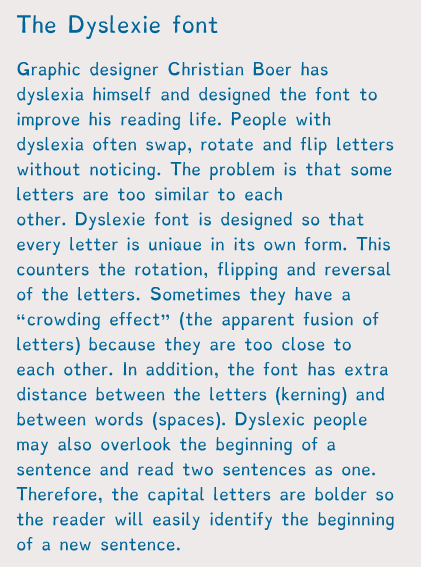
There’s also a dyslexic font designed especially for dyslexic people to read.
You can install on your tablets, laptops and browers etc, so not only can you change things like documents into it, you can change websites into that font as well!
I’m sure you’re bright enough to do a google search, but since I’m dumb enough to forget to post a link, here it is. Better late than never
I default to arial for this reason, but I will now be defaulting to verdana or dyslexie. nice.
I don’t think I have dyslexia but that dyslexie font was the easiest fucking thing to read ever. Books should be written in that shit.
ALSO!!!
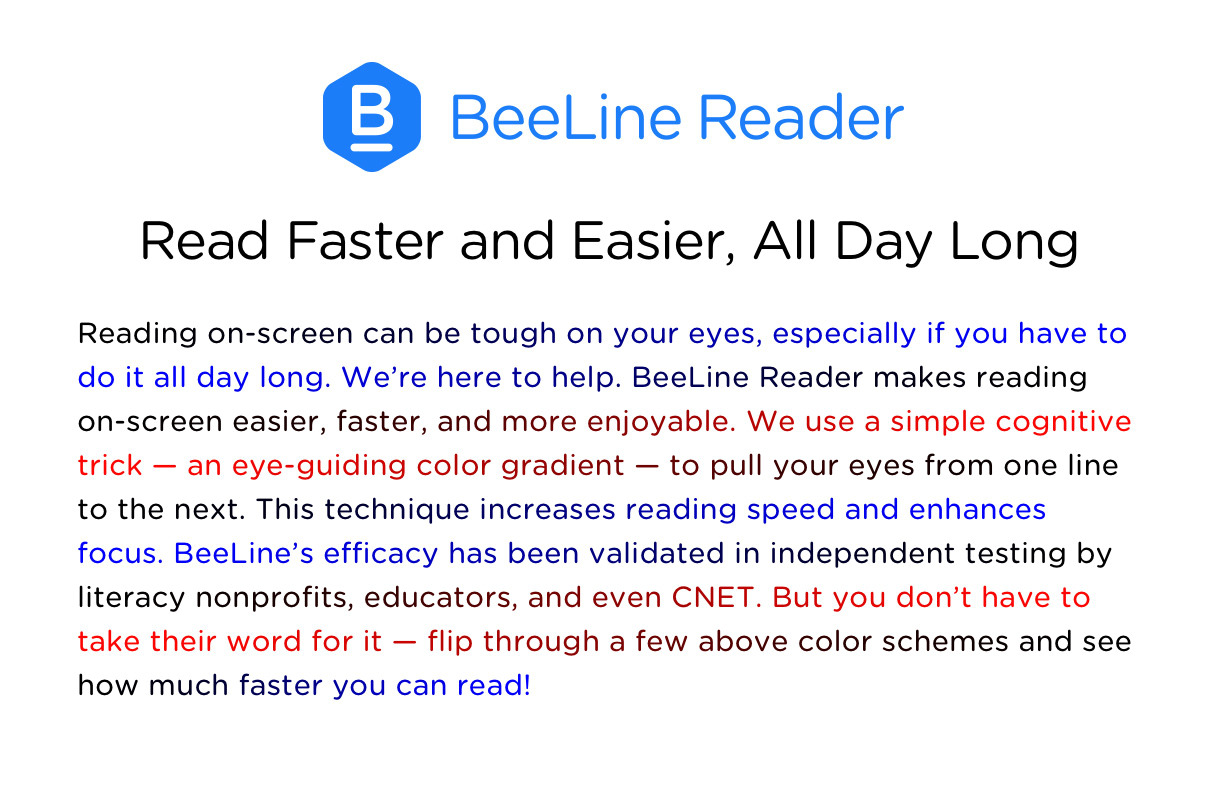
For computer reading, when you mix up lines of text, there’s a web browser app called Beeline Reader. It looks like this
The colors are also customizable, to an extent and while I don’t have dyslexia, I have adhd which makes reading large amounts of text harder and this helps A LOT.
I have literally never been able to read an entire paragraph without having to go back and figure out which line I’ve missed oh my god
BeeReader is actually going to change my life today
I’m glad we can continue hating Comic Sans.
Open Dyslexic is another font that’s available and when I found out it was on my Kindle I almost cried.



 Site Title