On a scale of “is occasionally forced to bathe” to “Instagram model with sponsors to hoe for” how involved is your OC’s Skincare routine?
What are your OC’s food preferences (flavors/textures/spiciness/calories/ when and how they eat) and how did they get that way?
What’s something pointless/petty/unimportant that IRRATIONALLY ANNOYS THE HELL out of your OC?
What’s your OC’s response to being asked for money by a homeless person?
Does your OC get lost easily? What do they do when they do get lost?
What would STOP your OC from Doing The Right Thing in a tense situation?
Realistically, could your OC (in their normal circumstances- i.e. at thier own house/battlecamp/spaceship etc.) keep a small child alive for a week if they had to? A Dog? A Houseplant? A rock with a smiley face painted on?
If your OC had to take the S.A.T. tomorrow with one night to prep, how would they do? both emotionally and academically.
What would cause your OC to chose to do something petty/pointlessly cruel?
On a scale of “Complete and Justified nervous breakdown” to “Conquer The Entire Galaxy and become an Immortal God-Emperor”, how well would your OC handle being abducted by Aliens?
What song is 100% garunteed to get your OC beyond turnt and will be sung loudly and emabarrasingly, either in public or the shower?
What perfectly-normal-to-them-thing does your OC do that confuses/pisses off/terrifies thier neighbors?
Under what circumstances would your OC appear naked in public?
What thing did your OC’s parents do that your OC wishes they had a better explanation for?
How often does your OC “zone out” or do things on autopilot and how severe have the problems that have arisen from that been?
How strong or weak is your OC’s Impulse control? What’s the worst thing that happened becuase of thier Impulsivity or inability to be so?
How does your OC sabotage themselves?
What’s the trashiest item in your OC’s wardrobe, when was the last time they wore it and why do they still have it?
How Dehydrated is your OC right now? Are they going to fix this?
What’s your OC smell like? no, not that “Vanilla and Anxiety” evocative stuff, realistically. Body odor? what have they been touching all day? When was thier last shower? Did they put on any kind of artificial scent?
Some 200 million years ago in the Triassic of what is now the Gokwe area of Zimbabwe as forest of Woodowrthia and other trees was engulfed in volcanic ash and slowly petrified into varied types of silica as this element was dissolved and remobilised by circulating waters. The piece of log in the photos is 18cm long by 6 across and coloured green by the presence of chromium, while its fossilised bark displays clearly where the tree’s spines once were. At some point in its long journey to the present through geological time, chromium rich waters passed through the buried stone forest and deposited salts, resulting in the deep green tinge that acts as a hygrometer, since it turns greener the more humidity is in the air. Chromium is a common agent of colour in gems, giving us the red of Rubies (http://on.fb.me/1gQbjaj) and the lovely greens of gems such as Emerald, Chrome Tourmaline (http://on.fb.me/1ixYQcu) and Tsavorite Garnet ( http://on.fb.me/1ygBzM5).
[”Quick #dnd #creator #dmtip! If you got MS Excel access & want to draw out some dungeons, just set your Column Width to 2.14 & your Row Height to 14.5 and boom, you got yourself some graph paper! Just use the fill command from there to color in the squares! Like so!”]
so metropolitan museum of art has a register of books they’ve published that are out of print and that you can download for free! they’re mostly books on art, archeology, architecture, fashion and history and i just think that’s super useful and interesting so i wanted to share! you can find all of the books available here!
I’ve been making jewelry for a number of years now. Pretty early on I was directed to a company called Fire Mountain Gems as a potential supplier. They sent a copy of their catalog with my first order, which introduced me to a *lot* of stones I’d never heard of… more than a few of which had trade names.
Now, understand, humanity has only relatively recently become fussy about how accurately they name their stones. For a big stretch of history, if it was reasonably hard and red OR dark red OR black with red highlights when you tilted it right, they’d probably call it a ruby. (Example: the Black Prince’s Ruby in the state crown of England, which is a completely different gemstone called a spinel, but they named it before the 1780s which is when we started being able to actually identify rubies as rubies. So… yeah.) Some kinds of gem have had lots and lots of different names all historically referring to the same stone. It makes for interesting reading of historic accounts of this or that piece of jewelry. I can excuse it, it was the past, really formal gemology is only a moderately recent thing.
But these days I go to the store and I see yellow gemmy-looking beads hanging on the rack, and I look at the sticker, and it says ‘yellow jade’, only the price is way less than that much actual jade would cost online. Or I go to look for smaller beads to match a few pieces of actual turquoise that I have on hand, and I realize that I have no idea whether African turquoise is actually turquoise or not. It gets… irritating. I want to actually know what the hell I’m paying for and whether it’s hard enough to risk putting it in a bracelet or ring, or whether it’s a softer stone that should be kept in earrings and necklaces, away from possible scratching or impact. If you’re buying jewelry, or if you’re looking for stones for jewelry work, or if you’re someone who believes in the metaphysical properties of stones and crystals, you’re going to want an accurate understanding of whatever it is you’ve got in front of you, right? Right.
So, yeah. Here’s a few of the trade names I’ve been stumbling over since I got started in jewelry making.
New jade – This is serpentine. It’s a pretty rock but it’s not jadeite or nephrite; it’s not actually jade. Serpentine’s way common, since it’s basically a form of one of the most common minerals in the earth’s crust.
Ching Hai jade – Dolomite plus a couple of other minerals. Pretty, but not jade. Let me put it like this: on the Mohs scale of mineral hardness, nephrite jade is 6 to 6.5 and jadeite is 6.5 to 7. Ching Hai jade is 3.5 to 4. This stuff is softer than the outer coating of human teeth (Mohs 5, same as a basic knife blade and most kinds of everyday glass). You want a stone you can put in a ring where it’ll get whacked or bounced off hard surfaces or otherwise stand a chance of impact, you’re gonna want real jade. Ching Hai jade will get scratched clear to kingdom come with a Mohs score like that.
Yellow jade – It’s quartz. Nephrite jade comes in a lot of colors including yellow, but if they’ve labeled it ‘yellow jade’ rather than saying ‘jade’ or ‘nephrite jade’ then it’s quartz. Same deal for ‘golden jade’.
Malaysia jade – Also quartz.
African jade – yep, still quartz.
Black jade – Both nephrite and jadeite come in black forms, but if a stone is being sold with the name ‘black jade’, it’s 90% likely to be serpentine. Actual jade gets labeled as jadeite or nephrite. I don’t do metaphysical stone foo, but man, if you’re buying a stone because you want to use its mojo, seems to me you’d want to get the actual stone associated with what you’re trying to do, not a stone that’s the same color and level of shiny.
Peace jade – Serpentine plus white quartz. I don’t even know where they came up with this name. It’s pretty but it’s jade the way a pommel horse is a horse.
Yellow turquoise – Serpentine again. Or rather, serpentine and quartz. At least this stuff comes from the same mines as turquoise.
African turquoise – Jasper. It’s turquoise colored, but it’s actually harder than real turquoise, for whatever that’s worth.
Italian onyx – They also call this one onyx marble. It’s a kind of calcite. Takes dye really well so they use it in different color forms.
African bloodstone / Indian bloodstone – Legit name for the actual stone, for once! These are both names for the same thing. They also call it heliotrope. So any of those names all refer to the same thing.
Tigerskin jasper – And we’re back to the malarkey; this is limestone. With pretty stripes, but seriously, it’s not even jasper and jasper gets used as a substitute for other stones so wtf.
Aqua terra jasper – Onyx marble. They also call it impression stone, but it’s marble, and it’s on the soft side as stones go. Marble’s around Mohs 3 on a good day. That’s another stone you can scratch with your teeth.
Green Earth jasper – NOPE. Serpentine. Sorry.
Peridot jasper – Serpentine. Seriously, do you have any idea how many stones with pretty pretty names are actually just pretty pretty names for different colors of serpentine?
Zebra jasper – onyx marble.
Chinese chrysoprase- Oh look it’s serpentine again
Lemon chrysoprase – This is magnesite. Not dyed, which is a little unusual. Magnesite takes dye really well and gets sold in a lot of colors as a substitute for other stones. Selling it as lemon chrysoprase means someone managed to get hold of a yellowish color of the stuff.
Mosaic turquoise – If it’s labeled mosaic anything, it’s almost always fragments of a stone bound together with resin, and probably not even the stone it claims to be. Mosaic turquoise is ittybitty chips of magnesite that’s been dyed to match turquoise color, then stabilized together as a single piece. It’s not even close to being turquoise.
Green opal – okay, quick lesson: there are different kinds of opal, and not all of them have the flashy color changing fire you get with precious stones like Welo opal or Australian opal. Mexican fire opal and Oregon fire opal are good examples of other forms. The actual stone we call opal is a specific kind of silica with a certain level of water content, not just the pretty flashiness. And opals of both the flashy kind and the non-flashy kind do come in green. But if they’re selling it as ‘green opal’, they are selling you chalcedony. Chemically similar, but not as pretty, and a distinctly harder stone.
Red malachite – This is marble. They find marble with banding that resembles malachite banding and they cut it and polish it to look like malachite, just in a different color. Malachite is green; this isn’t even a thing like jade coming in different colors. There isn’t actual red malachite.
Opaline – this isn’t even a stone. This is glass. Same deal with ‘sea opal’. Sorry. Sometimes they sell chalcedony as opaline but whatever it is you’ve found it’s not opal.
Fused quartz – Glass. This is glass. Fancypants glass, but it’s glass.
Goldstone, or blue goldstone: Also glass. With bits of copper in it to produce really nice sparkly effects, but it’s still a kind of glass.
Sand stone or blue sand stone: I only found out recently that some people sell goldstone as ‘sandstone’, so… this one’s glass too. Actual sandstone is a sorta brown sedimentary rock.
Black moss quartz – This is glass. Worth noting, there’s a vaguely similar product out there called rutilated quartz. That’s actual quartz with spindly intrusions of a different mineral, rutile. Difference is, the quartz has a Mohs hardness of 7 and will scratch the ‘black moss quartz’s’ soft bitch ass six ways from Sunday as a result.
Fordite – This is paint. Fordite is automotive enamel that’s dripped onto the same spot on factory floors for so many years that it’s built up to the point where it can be cut and polished and made into jewelry elements. Unlike a lot of trade names, this one isn’t a form of bullshit to pass one thing off as another. People who go looking for fordite are specifically looking for gemstone quality layered automobile paint. Sometimes they call it Detroit agate or motor agate, but that’s more of a joke than an attempt to sell the stuff to people looking for actual agate. I can live with this trade name.
Rainbow calsilica: Apparently there’s just a huge amount of argument about this and some people say ‘this is natural and we found it and it’s got pretty pretty stripes of all different colors just naturally and it’s a totally awesome metaphysical marvel of a totally natural gemstone’, but the Journal of the Gemological Institute of America says ’dude, you powdered carbonated rock and added paint and stabilized it with resin, wtf’. So yeah, be warned. I mean, it’s pretty and all, and you’ll probably pay way less for it than for chrysocolla (a natural stone with somewhat similar striping), but… be aware it’s probably something a guy in a factory or a lab put together, okay?
And citrine: Okay, this isn’t exactly a case of trade name bullshittery, but, uh. Natural citrine is stupid rare. Most citrine these days used to be amethyst. Take a crappy piece of amethyst with faint color or gray tones and heat the hell out of it long enough, and it turns yellow, and you can legally sell it as citrine. If you’ve got citrine crystals and the yellow color is most intense up in the tips, you’ve almost certainly got former amethyst there. Fair warning.
So… yeah. Lot of trade names out there. Some of them total bupkis. Some only partly so. Heads up, and if you’re in the market for a gem or a crystal or something like that, do yourself a favor and look up the name somewhere reliable first just so you know what you’re buying.
you know what’s wild is that all these crazy standards we hold ourselves to are things that we don’t even value in another person? like i’ve never been like “wow I love that this friend of mine is too proud to ask for help and never complains about their feelings” or “my favorite quality about this friend is that they get straight A’s and never get overwhelmed and has never told me about a problem” or “i love that this friend has never been wrong about anything or slipped up and said something embarrassing once in their life” and yet here we are, pushing ourselves past our limits for and beating ourselves up over slipups of things that our friends probably wouldn’t even rank in the top 50 reasons they like us
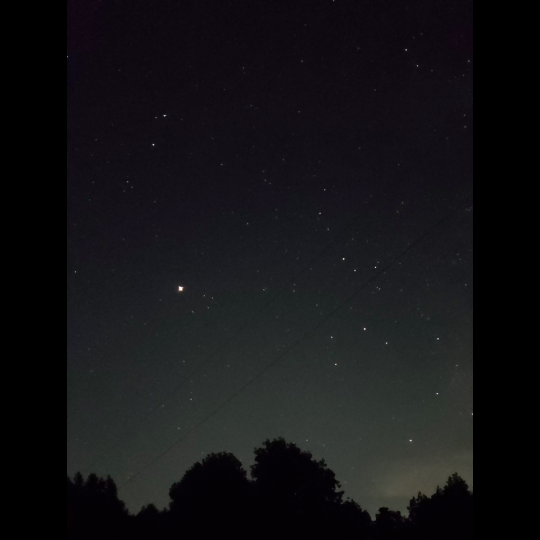
im very grateful for the lessons in photography i was taught in stop motion class because just now they made it possible to photograph the stars with my phone in spite of the camera usually not detecting the light of stars because theyre so dim,,,, enjoy these shiny motherfuckers
ok so if everythings normal, your phone camera should have a manual mode (sometimes called pro mode). in it, change the settings of the shutter lag to 20 seconds, then put the phone down on some stable, plane surface and press the photo button (usually when using your camera, the volume buttons can be used as photo button) and let the phone still for the whole 20 seconds.
(basically the problem with most cameras is that they dont have a very good light sensitivity in the dark, however that doesnt mean they cant detect it at all. the longer the shutter is open, the more light your camera takes in and the more burnt/light your pic will be, so in (literally) dark situations, make the shutter lag longer to get all that light you need! also i said 20 seconds but really you can make it shorter or longer depending on what kinda stuff you want for your stars)
Yes this!
Additionally, adjust your ISO to the highest number (mimics the film used for very low light and low speed images)
And set your shutter speed to the longest time possible (on my phone it’s 10 seconds).
Leave your focus settings on Auto, and if your phone camera has a timer option, turn that on (five seconds is generally enough).
Plan your shot first, then find a place to set your phone down so you can get the image you want. The less light pollution, the better; you’ll pick up FAR more stars in your picture.
Once you know what you want to shoot, tap your screen to “focus” it, then hit the button to take the picture, set your phone down, and back away from the “tripod”. Don’t touch your phone for a good 15 seconds, just to be sure.
You will not be disappointed in the results, let me assure you.





 Site Title