Part 2 of The Magnus Archives liveblogging; MAG023 to MAG033! (With some spoilers-that-I-shouldn’t-know-yet for later episodes, but significantly less than last time.)
(… it is long.)
AND THEY WERE… ROOMMATES………… (OH MY GODS THEY WERE ROOMMATES)
I find a big stumbling block that comes with teaching Romeo and Juliet is explaining Juliet’s age. Juliet is 13 – more precisely, she’s just on the cusp of turning 14. Though it’s not stated explicitly, Romeo is implied to be a teenager just a few years older than her – perhaps 15 or 16. Most people dismiss Juliet’s age by saying “that was normal back then” or “that’s just how it was.” This is fundamentally untrue, and I will explain why.
In Elizabethan England, girls could legally marry at 12 (boys at 14) but only with their father’s permission. However, it was normal for girls to marry after 18 (more commonly in early to mid twenties) and for boys to marry after 21 (more commonly in mid to late twenties). But at 14, a girl could legally marry without papa’s consent. Of course, in doing so she ran the risk of being disowned and left destitute, which is why it was so critical for a young man to obtain the father’s goodwill and permission first. Therein lies the reason why we are repeatedly told that Juliet is about to turn 14 in under 2 weeks. This was a critical turning point in her life.
In modern terms, this would be the equivalent of the law in many countries which states children can marry at 16 with their parents’ permission, or at 18 to whomever they choose – but we see it as pretty weird if someone marries at 16. They’re still a kid, we think to ourselves – why would their parents agree to this?
This is exactly the attitude we should take when we look at Romeo and Juliet’s clandestine marriage. Today it would be like two 16 year olds marrying in secret. This is NOT normal and would NOT have been received without a raised eyebrow from the audience. Modern audiences AND Elizabethan audiences both look at this and think THEY. ARE. KIDS.
Critically, it is also not normal for fathers to force daughters into marriage at this time. Lord Capulet initially makes a point of telling Juliet’s suitor Paris that “my will to her consent is but a part.” He tells Paris he wants to wait a few years before he lets Juliet marry, and informs him to woo her in the meantime. Obtaining the lady’s consent was of CRITICAL importance. It’s why so many of Shakespeare’s plays have such dazzling, well-matched lovers in them, and why men who try to force daughters to marry against their will seldom prosper. You had to let the lady make her own choice. Why?
Put simply, for her health. It was considered a scientific fact that a woman’s health was largely, if not solely, dependant on her womb. Once she reached menarche in her teenage years, it was important to see her fitted with a compatible sexual partner. (For aristocratic girls, who were healthier and enjoyed better diets, menarche generally occurred in the early teens rather than the later teens, as was more normal at the time). The womb was thought to need heat, pleasure, and conception if the woman was to flourish. Catholics might consider virginity a fit state for women, but the reformed English church thought it was borderline unhealthy – sex and marriage was sometimes even prescribed as a medical treatment. A neglected wife or widow could become sick from lack of (pleasurable) sex. Marrying an unfit sexual partner or an older man threatened to put a girl’s health at risk. An unsatisfied woman, made ill by her womb as a result – was a threat to the family unit and the stability of society as a whole. A satisfying sex life with a good husband meant a womb that had the heat it needed to thrive, and by extension a happy and healthy woman.
In Shakespeare’s plays, sexual compatibility between lovers manifests on the stage in wordplay. In Much Ado About Nothing, sparks fly as Benedick and Beatrice quarrel and banter, in comparison to the silence that pervades the relationship between Hero and Claudio, which sours very quickly. Compare to R+J – Lord Capulet tells Paris to woo Juliet, but the two do not communicate. But when Romeo and Juliet meet, their first speech takes the form of a sonnet. They might be young and foolish, but they are in love. Their speech betrays it.
Juliet, on the cusp of 14, would have been recognised as a girl who had reached a legal and biological turning point. Her sexual awakening was upon her, though she cares very little about marriage until she meets the man she loves. They talk, and he wins her wholehearted, unambiguous and enthusiastic consent – all excellent grounds for a relationship, if only she weren’t so young.
When Tybalt dies and Romeo is banished, Lord Capulet undergoes a monstrous change from doting father to tyrannical patriarch. Juilet’s consent has to take a back seat to the issue of securing the Capulet house. He needs to win back the prince’s favour and stabilise his family after the murder of his nephew. Juliet’s marriage to Paris is the best way to make that happen. Fathers didn’t ordinarily throw their daughters around the room to make them marry. Among the nobility, it was sometimes a sad fact that girls were simply expected to agree with their fathers’ choices. They might be coerced with threats of being disowned. But for the VAST majority of people in England – basically everyone non-aristocratic – the idea of forcing a daughter that young to marry would have been received with disgust. And even among the nobility it was only used as a last resort, when the welfare of the family was at stake. Note that aristocratic boys were often in the same position, and would also be coerced into advantageous marriages for the good of the family.
tl;dr:
Q. Was it normal for girls to marry at 13?
A. Hell no!
Q. Was it legal for girls to marry at 13?
A. Not without dad’s consent – Friar Lawrence performs this dodgy ceremony only because he believes it might bring peace between the houses.
Q. Was it normal for fathers to force girls into marriage?
A. Not at this time in England. In noble families, daughters were expected to conform to their parents wishes, but a girl’s consent was encouraged, and the importance of compatibility was recognised.
Q. How should we explain Juliet’s age in modern terms?
A. A modern Juliet would be a 17 year old girl who’s close to turning 18. We all agree that girls should marry whomever they love, but not at 17, right? We’d say she’s still a kid and needs to wait a bit before rushing into this marriage. We acknowledge that she’d be experiencing her sexual awakening, but marrying at this age is odd – she’s still a child and legally neither her nor Romeo should be marrying without parental permission.
Q. Would Elizabethans have seen Juliet as a child?
A. YES. The force of this tragedy comes from the youth of the lovers. The Montagues and Capulets have created such a hateful, violent and dangerous world for their kids to grow up in that the pangs of teenage passion are enough to destroy the future of their houses. Something as simple as two kids falling in love is enough to lead to tragedy. That is the crux of the story and it should not be glossed over – Shakespeare made Juliet 13 going on 14 for a reason.
I saw this in my emails and couldn’t see why I’d been tagged in it (all the while nodding vehemently along) and then I saw my tags and ah. Yep. Still forever mad at how badly Shakespeare is taught in most schools.
Wait but then why does Juliet’s mother talk about being already married younger than Juliet currently is?
Likely because her match to Juliet’s father was an arranged match to solidify family names and houses in order to avoid conflicts or to establish wealth. (It also serves to denote the tragic undercurrent of the play ie love is secondary to wealth and power.)
It wasn’t so uncommon for children of royalty or nobility to be betrothed from birth, or even symbolically married, in order to make alliances. But that doesn’t mean they were engaging in the kind of adult relationship we envision when we think of marriage today.
Which isn’t to say some people didn’t buck the norm and do horrible things
Margaret Beaufort is a prime example of this, which the Tudors would likely be aware of. Her first marriage contract actually happened when she was one year old. It was later dissolved and she was remarried at the age of 12, and her second husband, Edmund Tudor, did in fact get her pregnant before dying himself. She was 13 years old when she gave birth, and it caused major health issues for her and nearly killed her. When she survived it was considered miraculous. Which should tell you just how not normal this kind of thing was thought of even back then.
I agree with absolutely everything in this thread of discussion. Even so, my long-standing fascination with both Shakespeare and late medieval / early renaissance history makes it impossible for me to to reblog without throwing in my extra few cents:
I. Margaret Beaufort
In my mind, there are few cases that better demonstrate the tensions between medieval norms and medieval realities than that of Margaret Beaufort. Like many other women of her time, she had only one child surviving to adulthood:
Henry Tudor (later Henry VII and the founder of the Tudor dynasty). In that, Margaret wasn’t so remarkable: infant mortality made this a common enough outcome, though undoubtedly a tragic one.
Where Margaret’s case was exceptional is that Henry was also her only known pregnancy, without so much as a stillbirth, infant death, or even another pregnancy ever being mentioned in connection to her. In her own time, it was commonly assumed that her experience of childbirth at a very young age was what accounted for her barrenness, and even to us today, it doesn’t seem implausible to assume some kind of physical trauma that prevented later pregnancies from taking place, given all the medical knowledge we’ve accumulated about the risks of childbirth at either extreme of age.
But there was more to this. The vast Beaufort estate that came with Margaret’s young hand
were so valuable that, to 15th/16th century English minds, it perfectly explained Edmund Tudor’s motives for having been so reckless with the health of his wife: having an heir of his own would ensure that her lands would stay with him, in the name of any children they might have together, whereas the lands would pass to someone else if she should die before having a child. Of course, most men in that situation would have waited anyway, as a child whose mother died in childbirth was much less likely to survive anyway, so contemporaries portrayed Edmund Tudor’s actions as short-sighted and foolhardy at best, amoral and cruel and worst. But Fate must have a sense of irony, because Edmund died before his son was even born,
while
Margaret lived, and as aristocratic women tended to do in those circumstances, she was remarried to Henry Stafford, 1st Duke of Buckingham.
Since Margaret was Stafford’s first (and only) wife, he would have depended on her to give him any heirs at all, to whom he could pass on the lands he already had, let alone any of Margaret’s own (and it would be logical to assume that the Beaufort inheritance would have been no less tempting to Stafford than it was to Tudor). He must have at least hoped for children from her, and at the time, there wasn’t any reason to expect she was totally barren either: there was the traumatic birth to consider, but she was more physically mature when she remarried, and there was room to hope that widowhood had given her time to recover. And yet, despite all this, it seems few people (if any) were surprised that Margaret did not bear any more children. It didn’t seem to doom her relationship with her second husband either: on the contrary, Margaret enjoyed a happy relationship with Stafford for well over a decade until his death, so if there was any bitterness on his part over his lack of heirs, he must have managed it well. Even in the contemporary sources (who don’t tend to be charitable towards female figures), any blame for her barrenness is laid squarely at the feet of the various men who were her guardians in her early life, who clearly abused their authority over her for their own benefit, rather than to safeguard Margaret’s well-being as guardians are supposed to do (one of them being Edmund Tudor himself… he wasn’t supposed to even be in the running for her wardship, but Henry VI actually outright broke a promise he had made to Margaret’s father to let Margaret’s mother be her guardian in the event of his death).
This indicates to me even more strongly that late-medieval / Tudor people would have not only been sympathetic towards what Margaret and women like her had suffered, but also understood that neglectful attitudes towards the health and happiness of dependents have consequences. Shakespeare’s own words make this clear, at the beginning of the play:
Paris: Younger than she are happy mothers made. Capulet: And too soon marr’d are those so early made.
Tudor audiences would have understood these lines as the words of a benevolent father protecting his daughter from the advances of an overeager young suitor, invoking what seems to have been a Tudor-era trope that early marriages do not make for happy endings… not for the woman,
not for her family or husband, and certainly not for the children she
might otherwise have borne. Because Capulet came off as the “good father” in the beginning of the play, it makes it all the more shocking when his attitude changes and he becomes the all-too-familiar figure of the cold, uncaring patriarch who regards his children only as pawns*.
I imagine the juxtaposition would have invited Tudor audiences to feel
Juliet’s sense of betrayal as if it were happening to them.
* Jane Grey, the famed “nine days’ queen” was also rumored to be such a victim of her parents’ ambition: they also saw fit to force her into a marriage that she seriously objected to, and historical records point a fairly consistent picture of their callous disregard towards her wishes and genuine happiness.
II. Consent in Medieval Marriages
Twelve and fourteen are actually also important numbers in their own right, and Shakespeare’s choice to place Juliet between those two ages has an important symbolic meaning. Late medieval Catholic doctrine defined marriage as a sacrament, like the Eucharist (Communion), or Holy Orders. Many of the sacraments require those who receive them to understand what they’re getting into for the sacrament to have the desired effect. To guarantee understanding (at least from a theological perspective), you would have to be above “the age of reason”, the age at which you were considered to be able to think for yourself. Conservative definitions of the “age of reason” sometimes defined it as the age of fifteen or fourteen (or older), but was later fixed at twelve. Since marriage was one of these sacraments, a marriage where both spouses had not fully and knowingly given their consent was no marriage at all.* Therefore, twelve was considered the absolute lower age limit at which a person could marry without compromising the very spiritual foundation of the marriage itself, while fourteen was considered a safer age at which to assume the person had full control of their reasoning capacities.
The other side of the “consent” coin when it came to marriage was that consent wasn’t just a necessary condition to finalize a marriage, it was also sufficient condition. If a man and a woman had given their knowing consent to marry one another, and if they had intentionally verbalized this promise to one another and consummated their marriage, then no earthly power could invalidate this pact for any reason (outside of a few very specific ones, like incest) without risking damnation. Witnesses were convenient as a way to prove that the marriage had taken place, if a family member or some segment of society disapproved of the match, but they weren’t needed in order to make the marriage spiritually valid.
Basically, the Catholic Church at this stage somehow ended up putting
the idea of consent at the very heart of the idea of what made a marriage valid or not, and this had consequences not only because of the threat of hellfire, but also because Church law was secular
law when it came to domestic matters like marriage and divorce. And
then it came to pass that the English Reformation left this specific
area of the doctrine mostly
untouched, so the Tudors would have had similar ideas surrounding the
question of consent and marriage as did their late medieval forbears.
This theological point is not only the whole raison d’etre for the most central plot device in the play, but also adds an extra note of pathos to Juliet’s situation and an extra layer of moral judgment towards Lord Capulet’s behavior.
If she did not insist on keeping her marriage vow, or if she married
Paris knowing full well that she had already been married, both of those
would be mortal sins
for which she would risk damnation. And by extension, because he used
duress against Juliet to try to make her comply with his sinful wish,
Lord Capulet
has also damned himself (albeit unknowingly, but even so, the narrative
clearly presents forcing his daughter’s marriage as something he should
know better than to do, anyway).
Until this point, Juliet’s marriage is characterized as an impulsive decision such as only foolish youth could make, but ironically, in that confrontation with Lord Capulet, this slip of a young girl is now portrayed as conducting herself with far more spiritual maturity and grace than any of the adults around her. Her parents are failing in their duty towards her by putting their dynastic concerns ahead of her health and happiness (when it’s been made clear they already know this is a Bad Idea), and her Nurse, who actually knows about the secret marriage and all the reasons why it cannot be taken back, is actively pleading with her to just forget it and pretend Romeo never was. Juliet’s choice here is monumental, because it involves not only disregarding her parents, but also an active decision to completely break with the woman who has been with her for literally everything in her life up to that point, a break so thorough that even Nurse herself doesn’t know that it’s happened. This dramatic turning point is a bittersweet portrait of the girl losing her innocence and growing up into an adult, from one angle, and from another angle it’s a paean to the pure-hearted idealism (different from the limpid innocence of childhood in that it’s willful and risk-taking, and fiery in quality) that can only be found in the young. Either way, it does Juliet’s character AND Shakespeare’s dramatic talents a massive disservice to portray her situation as something so simplistic or reactionary as lovelorn pining after an absent boyfriend, or rebelling against her parents, or “staying true to her own heart”.
This wasn’t just a plot device for the stage: many real-life lovers leaned on this feature of the Church’s teachings, when faced with the opposition of their families and communities, and in many cases, the Church was indeed forced to side with the couple, however reluctantly. Margery Paston, the daughter of a genteel landowning family
in the 15th century, and Richard Calle, the Paston family’s longtime housekeeper, were one such case of a real-life Romeo and Juliet: they mutually fell in love, and married in secret when they came up against heavy opposition from Margery’s family. The Pastons responded by separating them, firing Calle from his job and having him sent to London, while Margery remained in Norfolk under house arrest. There, she seems to have been subjected to ongoing and intense pressure to walk back her marriage… if the couple had been married formally in church, this would not have been possible, but secret marriages were vulnerable to challenges like this because they were secret. A witness would have helped her and Calle’s case and made it more airtight, but even if the couple had had any, apparently the Pastons had succeeded in intimidating them into silence.
But even though the Pastons seemed to be winning, it’s hard to believe that bystanders wouldn’t have objected to at least some of what the Pastons were doing to try and get their way. Otherwise, Calle could not have written Margery in 1469, during their separation, saying
“I suppose if you tell them sadly the truth, they will not damn their
souls for us”. Their situation was objectively quite bleak.
For the months they were apart, it was made very clear to both Margery
and Calle that, if the
couple continued to insist on their marriage, the Pastons would disown Margery and throw her out of the house, therefore leaving her with few options for survival, let alone to find her way to Calle over a distance of a hundred miles.
He mournfully acknowledges that their gamble might fail, and their worst fears might come true, but there is also defiance in his resignation, as he concludes, “if they will in no wise agree [to respect our marriage],
between God, the Devil and them be it.”
Margery, for her part, was no less determined. When Margery was finally brought before the local bishop, he turned out to be sympathetic towards the Paston family, and gave Margery a long speech about the importance of pleasing her family and community (so much for the theological importance of consent, but then, clerical hypocrisy was nothing new to medieval people). But Margery remained steadfast (in fact, I am inclined to think from her next words that the bishop’s words only goaded her to greater resolve) and when she spoke, she not only continued to insist that she had said what she had said, but according to her mother she “boldly” added, “if those words made it not sure […] she would make it surer before she went thence, for she said she thought in her conscience she was bound [in marriage to Calle], whatsoever the words were.” Her wording left absolutely no room for doubt in the mind of even the most flexible theologian. And when Calle was cross-examined and his testimony found to match that of Margery’s, the bishop of Norfolk had no choice but to rule in the couple’s favor.
Margery’s mother did indeed make good on her word: she did both disown Margery and throw her out of the house. She seemed to have done it more to save face, however, than to actually punish her daughter, since she does seem to have made arrangements behind the scenes for Margery to stay with sympathetic neighbors. In the end, Calle was right, the Pastons were not willing to risk their own souls. Margery and Richard Calle got their happy ending, and had at least three children (and we know about them because we know Margery’s mother left them money in her own will).
*
This also meant that Edmund Tudor actually would have been Margaret Beaufort’s first
husband, not her second. It was true that she had already been “in a
marriage” before being married later to Tudor, but strictly speaking, it
was only a precontract (what we today would think of as an engagement)
with signficance limited to the secular realm; there are a lot of
reasons this would not have really been considered a marriage at the
time, but the most theologically pertinent one is that the bride’s
consent could not have been involved, because she was too young to be
able to give it. Consequently, this paper marriage was easily
dissolved as soon as her guardians thought it more politically expedient
to marry her to Edmund Tudor.
And for all intents and purposes, Margaret Beaufort herself considered
Tudor to be her first husband, not John de la Pole.
tl;dr: the study of Shakespeare cannot be separated from historical and societal understanding of the times he lived in, and frankly, it’s a terrible shame that English classes don’t emphasize this more, because then you’re throwing out about 80% of the meaning his works actually hold.
Sorry to keep reblogging this long post but holy shit this is an excellent addition. Thank you for taking the time to write all that up.
When I first got into fandom, I feel like I did it in the way that you hear about it: I watched a thing (for me it was always watching), and I loved it so much that I wanted *more,* and then I sought out fic, and then I waited to feel like I had something I needed to say about it. This is what people will traditionally tell you fandom is.
But, Idk, as I’ve gotten older, I have shifted this. Fandom has become more of a habit, a general way in which I interact with creativity, rather than a specific reaction to *someone else’s* creative work. Which isn’t how fandom is traditionally defined but is how I do it, and I guess I’m writing this out to see how odd this is, and where this impulse comes from within me?
Because it’s been a while – a very long time – since I consumed a piece of media that I loved so much I wanted to seek out the fic. I have tried. I have consumed all of the things that are big fannishly now. None of them really caught my creative spark.
The first thing to catch my creative spark after Sherlock was in fact Inception. Not because I’d seen the movie (which I had seen, and barely remembered). But because the Inception *fandom* seemed kind of amazing. I read a fic, and then another fic, and then more fics, and then I was performing what I now call my Fandom Anthropology. I dug through historical layers, uncovering old rec lists, ending up on old LJ kinkmemes, letting them link me to other things, finding fanvids, going through meta, until I had assembled a picture of what I thought the fandom was doing, what the fanon conventions were, which pieces of canon were the most important. It was like settling into an entirely different mental location and mapping it out like a tourist.
Since the Inception rabbit hole, I have always consistently come to a fic-reading rabbit hole not from the canon but from the fandom itself. I subscribe to authors on AO3, and whenever they update with a fic, I tend to click on it curiously. I am such that I can tell right away if I’m going to be caught by a ship or not. I’m actually fairly predictable in what I like, tbh. I’m sure you can pick up on my preferred OTP dynamic. 🙂
I read all recs sent to me, but not all of them necessarily hit me at the right time. And then suddenly something will catch me and I’ll just spend a little while devouring everything I can in that universe. I did that with Social Network RPF (which I revisited this summer and it remains delightful) and Sports Night (which was a show I’d been fannish about in the early 2000s before being fannish was the more organized thing it is today) and Marcone/Dresden from the Dresden Files (I read some Dresden Files many years ago, but left off before Marcone even entered the narrative) and for a little while I read a bunch of Raven Cycle fic (despite never having read a word of these books). There was a small attempt to explore BTS fandom but I found it a little impenetrable (I couldn’t get a handle on the characters); I also tried to read some One Direction stuff but mostly got distracted that no Harry Styles was like how he was in my head (Idek, I barely listen to One Direction, I have no idea where my very clear picture of Harry Styles came from, but I kind of think he’s a delight, he’s just my fave).
But, anyway, the point of all of this is: I read fanfic these days not because of inherent interest in the canon but because writers I like are writing in it. And if I like the characters they write well enough, then suddenly I’ve opened up a ton more fic that I can read. As far as I can tell, I am treating fic as original writing. I come to it with little knowledge of the characters. All I know about it is its *genre.* And fic is definitely its own genre. I know the basic shape of everything that’s going to happen in every fic I click on, so I’m entirely reading because something about the characters have caught me. Not because of canon, but because of *fanon.* Because, Idk, so often it’s the fan artists who are really creating this marvelous complexity, and I feel like I’m just cutting out the middle man. And, once I’ve been caught by a dynamic, lucky me, it’s super-easy to find a million other ways to explore those characters. And the canon of them is entirely secondary to me in the first exploration, and then eventually becomes part of my excavation of what’s going on.
Is this a weird way to do fandom? I feel like it might be. But also I don’t think it’s necessarily the *wrong* way. It might even have always been my preferred way, but before the age of AO3 and Tumblr, it was actually harder to jump between fandoms. I know you *could* do it on LJ, but I remember when I switched from DW to Sherlock, having to be like, “Hey, were are the Sherlock people on here? Where do I find them?” Whereas now it’s just all simpler to run productive searches that get you what you’re looking for. Or just asking on Twitter, “Hey, who knows anything about this fandom and wants to point me to the best fics?”
This has been, for me, a far more reliable way to discover things I love than to sit around waiting for a canon to find me. I would never have randomly rewatched Sports Night last spring had a Sports Night fic not crossed my inbox. I would not be listening to nonstop Fall Out Boy had a random bandom fic not crossed my inbox. Fandom is the thing I use to introduce me to mainstream culture; not the other way around.
And, tbh, I am kind of enjoying doing it this way. I guess the main thing I fear about it is that I probably miss canon the first time around, because it turns out I find myself letting the *fandom* seduce me in. So, like, I know Fall Out Boy songs, and even had friends in bandom, and paid, like, zero attention to anything fannish, until I started reading bandom fic, and then I had to perform Fandom Anthropology, and uncover old LJ posts and new Tumblr primers and long lyrical analyses (that are WAY better than any analysis of any FOB lyric on Genius, those analyses are…weird, Idk).
So, Idk, in ten years I’ll probably finally get the huge appeal of the big fandoms today. There’s a possibility I’m bad right now, at this point in my creative life, at, like, being part of the *active* fandom formation part of things. Which I don’t say in a way to imply that I’m annoyed with myself, because I’m not. I am doing lots of original writing because that’s apparently what I’m in the mood for and life is too short to fight with the things you want to write about, and6 being part of an active fandom is a very different energy than just kind of passively enjoying a fandom. If that makes sense? And I think you just go through cycles. My most creative fic periods coincided with a lot of soul-searching transitioning in my life as I staggered into my career. I feel like I’ve finally got a bit of a handle on who I am? And that feels a little bit like it’s unlocked an original writing impulse within me that honestly had been dormant for many, many years.
Which is all to say: Being creative is an all-over-the-place experience. If you roll with it, you never know where you’re going to end up. And the key, I think, is to learn to just go with it without judging yourself too harshly for it. There’s no wrong way to do creativity. I don’t think there’s a wrong way to do fandom, either (apart from being a bully, of course). The universe is infinitely expanding.
I love this description of process – so clear and so interesting! This is not how I’ve done fandom… so far. But I have a bunch of fans with a similar process to this. One of them has never seen Sherlock and wrote to me a bit ago, “omg have you read How The Mouth Changes Its Shape???” and then proceeded to offer me several other recs as well. 😀 And apparently there used to be whole lj communities devoted to explaining canons so you could dive into fic without having consumed them. I’m delighted that many people do seem to read fic as a genre, and that some are still diving into fandoms of long ago (I do that part).
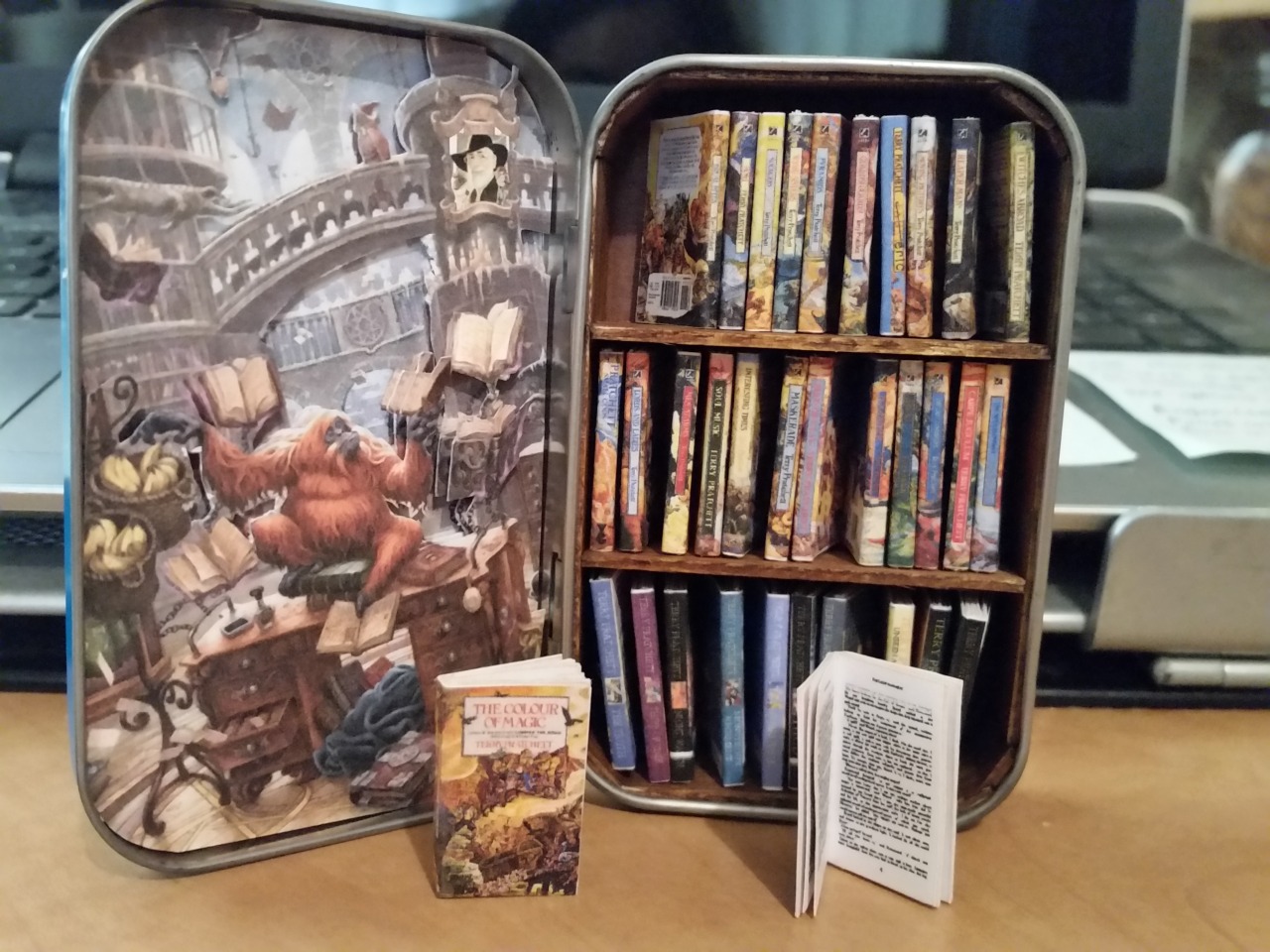
My miniature Terry Pratchett Discworld novel library!
Made from an Altoids tin, Popsicle sticks, cardstock, copy paper, and a whole lot of patience. All of the miniature books open and have real printed pages you can leaf through. And the insidevof the lid has a sort-of-3D scene of the UU Library.
Contains the novels from The Color of Magic, all the way through Raising Steam
Every time a post on queerplatonic relationships makes its way around tumblr, the comments are inevitably filled with a flood of “IT’S CALLED FRIENDSHIP” or “WHY DO YOU NEED A WORD FOR THIS.”
Do you honestly think society regards friendship as an acceptable substitute for romance and marriage? The thing is, most aros would LOVE if it could just be called friendship.
Because that would mean a world where:
Friendships are considered equal to or sometimes *SHOCK HORROR* more important than romantic relationships. This is not an exceptional occurrence.
Romantic partners know that they might not be their datemate’s Most Important Person and are not bothered by this.
People commonly plan major life events around their friends up to and including housing, finances, employment, ect.
It is common for people to be in their 30s, 40s, 50s, hell even old age having lived with friends that entire time and no one has ever asked them why they’re not married.
It is common for people to have a committed lifelong partnership with their friend and no one bats an eye.
Having a life friend is considered something that can be regarded as equally close to marriage. It is also taken just as seriously.
Until the day that those are true, friendship is unfortunately not an accurate word to convey the types of relationships we’re talking about.
The level of vitriol and condescension in some of the notes to this post are really striking. Direct quotes:
“So…all of this is common?? Unless you are very young or are living under a rock?”
“PLEASE go outside and quit posting this fucking nonsense”
“lmaoo how is the solution to this making up a ridiculous word to describe committed friendships”
“FOR FUCKS SAKE. PLEASE LEAVE YOUR FUCKING HOUSE ONCE IN A WHILE AND TALK TO SOMEONE, LITERALLY ANYONE. MAKE. SOME. FRIENDS.”
“i’m 100% convinced that none of u on this site have ever left the house or had a friend”
And so on. There are also plenty of folks positioning the OP and others who relate to this kind of language and/or this kind of relationship as in opposition to the “real” LGBT+ community, presumably due to an assumption that only asexual or aromantic people find themselves in relationships like this, or would want a word to describe them (and the accompanying assumption that aromantic and asexual people aren’t “really” queer). There seems to be a feeling that, by creating this word or attempting to articulate a particular subset of the larger category “friendship,” OP and folks like them are taking something away from some other group of people—whether that’s because they’re usurping the language of queerness undeservedly, or just making an annoying bid for attention, or because they’re somehow impoverishing the social perception of friendships that don’t fall into this category.
As a data point: I’m neither very young nor living under a rock. I’m 37; hold down a human-interaction-heavy, management-level job at a nonprofit; have a regular Ashtanga yoga practice and am training for a 10K run; formerly owned a clothing design business; have lived in three major, extremely left-leaning, west-coast cities over the past four years and still maintain friendships with a wide diversity of people in all of those places as well as in many other places across the world; just visited one of my best friends since kindergarten, who now lives in Manhattan: also a major, left-leaning metropolis. It happens that I am neither asexual nor aromantic, and generally have active lovers/friends-with-benefits relationships going with between one and three women at any given time. I also live with my best friend/writing partner/committed life collaborator/Best Person (@greywash/Gins)—I have done for four years now, across three different apartments in two different cities, and I have concrete plans to continue doing so in the future. We eat together; write together; do projects together; go on vacation together; take each other to doctor appointments; we’ve gone on trips with both sets of our parents; the two of us just visited my hometown for a major family event, where I reconnected with a wide network of family & friends, and introduced her to all of them, etc.
As such, I’ve spent a lot of time talking with a lot of different people—real, meatspace humans, in face-to-face conversations—about my domestic situation. And I’m here to tell you: arrangements like this are not, in my experience, “really common,” even in the big liberal city. And for many people, they’re not intuitive to grasp. People are extremely uncomfortable with relationships that tick some of their Relationship Escalator buttons but not others, and they work very hard to find a way to make the thing they’re observing fit their preexisting relationship models. I’ve frequently encountered:
People telling me we shouldn’t get too “serious,” because what will happen when one of us falls in love with one of our sexual partners? (Assumptions: having sex is the universal falling-in-love trigger; being in love is necessarily accompanied by having sex and doesn’t happen in its absence; sexual/romantic relationships are intrinsically more stable/serious than relationships that are only one or neither of these things; seriousness is synonymous with long-term stability; long-term stability is the universal goal.)
Sexual partners being extremely over-invested in knowing whether Gins and I have sex, even though they know I am otherwise non-monogamous, and only feeling secure if the answer to this question is no. (Assumptions: a relationship, however close or committed, doesn’t become a “real threat” unless sex is in the picture; also that there is an easy yes/no answer to the question “Are you sexually involved?”)
People positing a dichotomous understanding where either (a) she and I are roommates, implying a relationship of convenience that carries little to no commitment (“What will you do when Gins moves to the Bay?”), or (b) we’re romantic/sexual partners, which carries an assumption of jealous monogamy (“Is Gins okay with you going out to the lesbian bar with your BFF?”). (Assumptions: relationships come in pre-packaged units, with levels of commitment, exclusivity, and sexual and romantic expression pre-set.)
People making all kinds of hurtful and often stereotypical assumptions about our interpersonal dynamics in order to explain why our relationship doesn’t look more “normal.”
On the “bid for attention” front: because we don’t want to have this kind of involved conversation with every person with whom we casually interact, Gins and I often use other shorthands to refer to one another. I don’t go around introducing her as my “queerplatonic life partner” or even my “hard-to-define life partner” unless I have a pretty good idea that the person I’m talking to will understand what I mean by that, or they have a genuine need to know. (Though, on the flip side: if they do understand what I mean by that, it’s usually a good sign we’ll get along.) Depending on the context, we tend to either use the word “roommate,” which feels painful to me because it downplays our importance to one another, or the catch-all word “partner,” which at least to me feels a lot truer and more validating, but can come with some inconvenient assumptions about our sexual/romantic involvement since many people process “partner” as essentially meaning “wife/girlfriend,” and “wife/girlfriend” as essentially meaning “monogamously sexual/romantic.” In any case, it’s not my goal to get on a relationship terminology soapbox with everyone I meet; quite the contrary. But that doesn’t mean that there isn’t value in being able to articulate to myself and my close circle how the relationship actually works.
I do understand the instinctive reaction against a perceived insistence on granular labels. I sometimes feel this way when I feel pressured to label my own sexuality. The term I’m most comfortable with is simply “queer,” because while I am now and always have been near-exclusively sexually and romantically interested in women, I also spent 12 years of my life in a relationship with my male band-mate and art-making partner, a connection which continues to be very important to me. “Lesbian” feels erasing of that important relationship, whereas “bisexual” radically overstates my interest in men. I exist in a place where neither label is all that usefully descriptive of my lived experience—which incidentally makes the frequent intra-queer bickering which assumes a clear experiential line between bi women and lesbians, pretty confusing for me. So I get how labels can feel constricting when they’re not useful to you personally. But I also understand that many people find granular sexuality labels to be extremely meaningful! Nobody should be pressuring me to adopt them, but on the other hand, it’s no skin off my nose that other people find power and useful descriptive force in claiming their bisexual or lesbian or gay or whatever identities. Calling myself queer doesn’t invalidate folks who call themselves lesbians, and them calling themselves lesbians doesn’t devalue my use of queer.
Similarly, articulating a term for a specific type of friendship doesn’t devalue the blanket “friendship” category. And I’d like to point out that there are already granular terms for many different kinds of friendship currently in use, and historically there have been many more—including terms that, like “queerplatonic,” explicitly seek to straddle or complicate the division between friendship and another category. I quite like the idea of repurposing the 19th-century term “Boston marriage” to describe my own arrangements, and the 18th-century concept of a “romantic friendship” or “passionate friendship” resonates with many other sapphic women I know. None of these terms are simple synonyms for modern-day terms like “lesbian lovers” or “best friends”—although there was undoubtedly overlap among those concepts—but unique historical formulations of their own. At some point, someone had to come up with these terms to describe what they were living through and observing around them, and that process applies just as much to the present day as it did in 1890 or 1780. Right now, scrolling through my contacts list in my phone, I see people that I would categorize as: acquaintances, college friends, friends with benefits, former friends with benefits, art friends, yoga friends, fandom friends, knitting friends, activism friends, childhood friends, best friends, family friends, work friends, potential friends, ex-friends, Portland friends, LA friends, close friends, and casual friends. And my queerplatonic life partner, who feels different to me than these other categories, just as they are all different from one another.
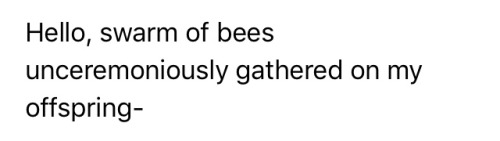
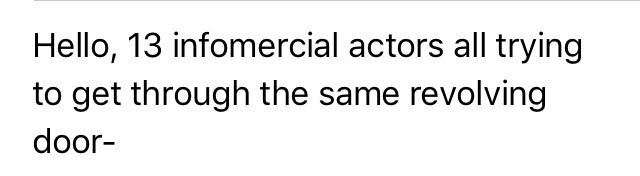
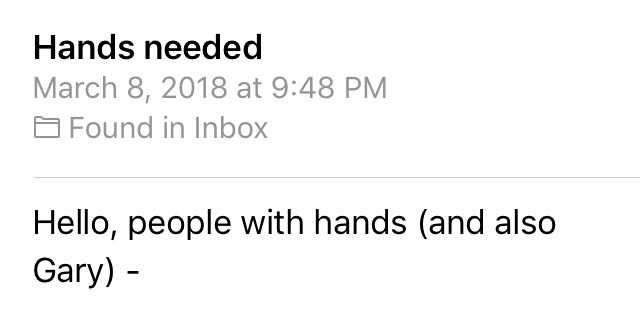
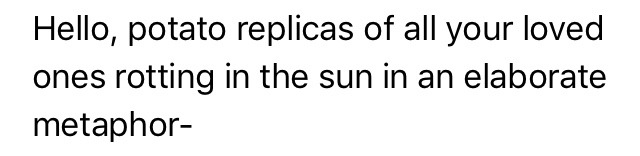
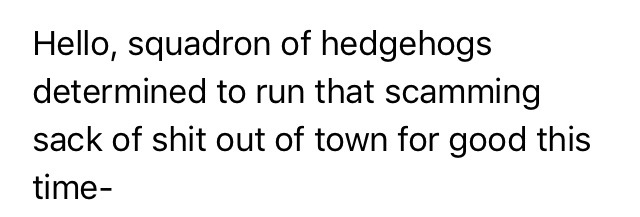
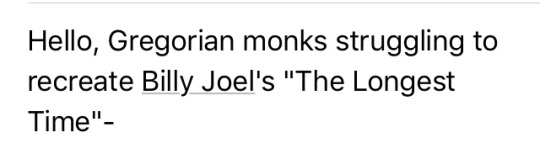
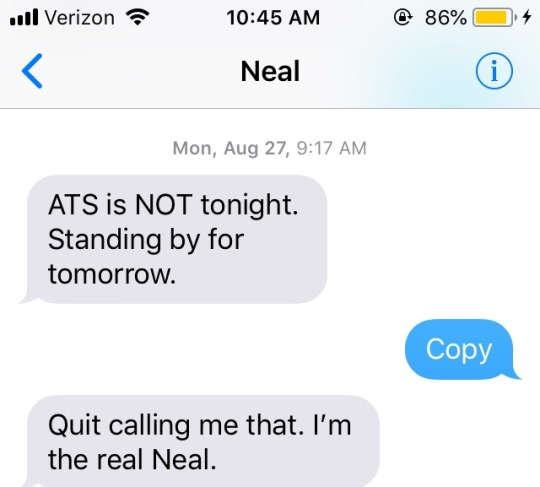
Freelancing in technical theater means you’re on a lot of different email lists. People need a crew, they send out an email, you respond with your availability. Now, most people start these with things like “hey folks” or “hi everyone”. Neal is not most people.
His openers started off innocent enough.
Then, he started to push boundaries.
And as you can see, it has spiraled out of control since then.
Tag yourselves. I’m the anteater in a suit who thinks he can pass.





















































 Site Title