Here’s a little trick I’ve used in D&D games where the premise of your campaign calls for the party to have access to lots of Stuff, but you don’t want to do a whole bunch of bookkeeping: the Wagon.
In a nutshell, the party has a horse-drawn wagon that they use to get around between – and often during – adventures. This doesn’t come out of any individual player character’s starting budget; it’s just provided as part of the campaign premise.
Before setting out from a town or other place of rest, the party has to decide how many gold pieces they want to spend on supplies. These funds aren’t spent on anything in particular, and form a running total that represents how much Stuff is in the wagon.
Any time a player character needs something in the way of supplies during a journey or adventure, one of two things can happen:
1. If it’s something that any fool would have packed for the trip and it’s something that could reasonably have been obtained at one of the party’s recent stopovers (e.g., rations, spare clothing, fifty feet of rope, etc.), then the wagon contains as much of it as they reasonably need. Just deduct the Player’s Handbook list price for the item(s) in question from the wagon’s total.
2. If it’s something where having packed it would take some explaining, or if it’s something that’s unlikely to have been available for purchase at any of the party’s recent stopovers (e.g., a telescope, a barrel of fine wine, a book of dwarven erotic poetry, etc.), the player in need makes a retroactive Intelligence or Wisdom check, versus a DC set by the GM, to see if they somehow anticipated the need for the item(s) in question. Proficiency may apply to this check, depending on what’s needed. The results are read as follows:
Success: You find what you’re looking for, more or less. If the group is amenable, you can narrate a brief flashback explaining the circumstances of its acquisition. Deduct its list price (or a price set by the GM, if it’s not on the list) from the wagon’s total.
Failure by 5 points or less: You find something sort of close to what you’re looking for. The GM decides exactly what; it won’t ever be useless for the purpose at hand, but depending on her current level of whimsy, it may simply be a lesser version of what you were looking for, or it may be something creatively off the mark. Deduct and optionally flash back as above.
Failure by more than 5 points: You come up empty-handed, and can’t try again for that item or anything closely resembling it until after your next stopover.
As an incidental benefit, all the junk the wagon is carrying acts as a sort of ablative armour. If the wagon or its horses would ever take damage, instead subtract a number of gold pieces from its total equal to the number of hit points of damage it would have suffered. The GM is encouraged to describe what’s been destroyed in lurid detail.
This type of method makes it *way* easier to keep track of items, and… it’s pretty darn funny when the players succeed a roll to see if they backed something outrageously stupid. Trust me, the flash backs are hilarious. Never skip out on them.
For when you want some variety for your tabletop RPG. These events will also give your players a chance to use character skills they don’t often have opportunities for.
Natural Disaster – Have the town the PCs are in catch on fire and see what they do! Do they cut their losses and run? Do they heroically try to save trapped townspeople? What do they do about the aftermath? Natural disasters are an interesting challenge because there can be lots of danger and drama without necessarily having a villain. It may also get your PCs to use skills they don’t commonly have a chance to. You could also try floods, earthquakes, raging storms while at sea, etc.
Powerful Fortress – Put one of your party’s goals in a location where they won’t be able to prevail through combat alone (Example: a fortress where they are vastly outnumbered). Your players will have to rely on either stealth or guile (or both) to accomplish their goal. The pacing of such events can be frustrating to some players, but few sessions are as rewarding as a creatively executed heist or infiltration.
Dangerous Crossing – Give them a dangerous physical obstacle to overcome. A canyon, or a raging river, or quicksand or an old battleground littered with traps and mines.
Festival – Have the PCs encounter a festival or tournament! With lots of contests! This could be a good opportunity for them to build their fame and fortune (especially if you allow gambling). Some of my favorite sessions have involved festivals.
Entertainment – Put the PCs in a situation where they have to entertain someone. What do they come up with?
Letter – Have one of the PCs receive a letter, either from an NPC they’ve dealt with before or from someone involved with their backstory. This is a good way to make the consequences of their actions seem more real. You can also use it to introduce new plotlines/sidequests.
Crafting Challenge – Put the PCs in a situation where they need to craft something in order to accomplish their goal. Maybe they need to make something in order to fix a mechanism? Or in order to satisfy some local gift-giving custom? Or they need a forgery? Maybe as part of an exchange for something else they need?
Lost and Found – Have your PCs discover someone or something that is clearly lost. Maybe they find an infant in the wilderness. Or a key with a strange inscription, or some kind of talisman. Throw in a clue or two to present your players with a tantalizing mystery.
Inhospitable Wilderness – Have the PCs go somewhere it’s an effort just to survive. A barren desert, a treacherous swamp with poison gasses, a forest so dense the ground never sees the sun, or even the bottom of the ocean. Test their endurance and survival skills!
Dinner Party – Have the PCs be summoned to a formal event! Test them on the battlegrounds of social grace and etiquette! Even better if it’s in a dangerous environment or an alien culture.
Thief – Have something important stolen from the PCs. See how they handle it.
Needle in a Haystack – Give the PCs something very difficult to find. Like a single specific housecat in a sprawling metropolis, or a legendary weapon of which there are many fakes/copies.
Really, if you need any more inspiration, look at your player’s character sheets and see if they’ve invested any points in a skill they haven’t gotten to use much. Then invent a challenge they could feasibly use that skill for. If you can’t think of a situation that could be helped by an Appraise, Craft: Calligraphy or Handle Animal check, you need to practice your own creative problem solving skills!
I don’t know if anyone’s seen the absolutely wild reward cards you can get through the Worldbuilders fundraiser right now – they’re basically cards you can present during a D&D game to get a special ability for a bit, themed after important DMs or actual play characters in the D&D community – but all of them (and the page talking about them) are absolutely wild and good for a laugh even if you can’t support the fundraiser
Behold:
I don’t know how I’d even feel about seeing one used in a game (many of them seem much better suited for a humorous campaign) but they’re absolutely hilarious regardless. There’s one for Magnus Burnsides that lets you change a low roll to an 18 and the page accuses Travis McElroy of lying about his rolls. Griffin is give the title “Much-abused GM.”
There’s even a reward card from Mike Mearls that just lets you become the DM for a minute, which feels like the only possible way to try to capture his deeply chaotic energy
Oooh! A good and important question! It’s definitely something I’m still working on myself, and I might be incorporating a mechanic into the game that lets players accrue friendship points and use them to change the world, but here are some tips:
Don’t push it too hard at the beginning. It’s much more rewarding if these things develop at their own pace.
Down-time is your friend. Just think of how many good character bits we get during the Lunar interludes in TAZ! You can go the interlude route and have set time between missions where characters can go on sidequests and develop their relationships with each other and with the NPCs, but it’s something to think about all the time. Are they walking somewhere or pausing for a rest? Ask what they’re talking about. Are they going to bed after a long day? Let them narrate how they go about it and if they talk to any of their friends. I mean, really this is just an important characterization thing in general, but it’s also when we’ve had some good friendship moments.
Set up challenges that require the party to work together in different ways–not all based on strength and magical prowess–and give them time to debrief afterwards.
Use sparingly, but last week’s session proved that if you emotionally torture the party you will get a lot of hugs out of it!
Remember that different characters will have different ways of expressing their friendship and different rates at which they’re comfortable doing so. As you get a better sense of the characters, tailor your game and challenges to fit them.
As I said, I’m still learning, so if other people have advice they should feel free to add to this post!
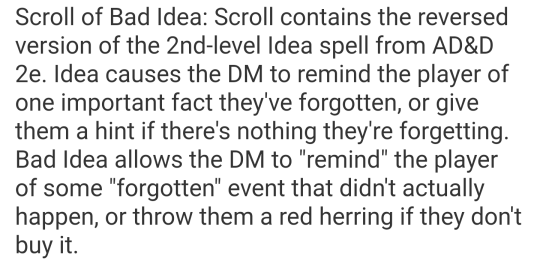
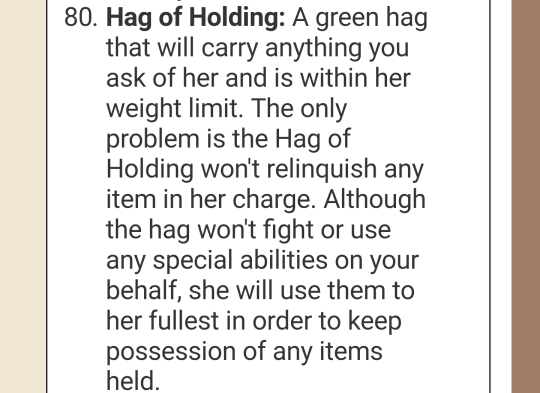
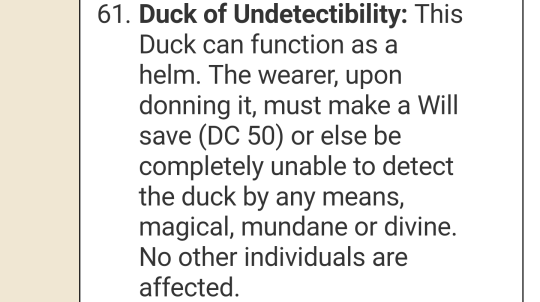
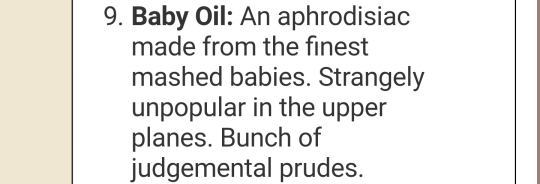
So I was having a lovely conversation with @princeofsparrows about magic and magical items and he sent me several links to very useful lists and tables. Those can be used by any DM to improve the game and set some more fun/challenge into the game without adding enemies or limiting themselves to always better armors and weapons.
My players usually discuss for an hour about the best way to open every door with a single rune on it (even if the rune actually just means “toilets”). So if I give them an omniously glowing fork and they will turn around it for half of the evening…
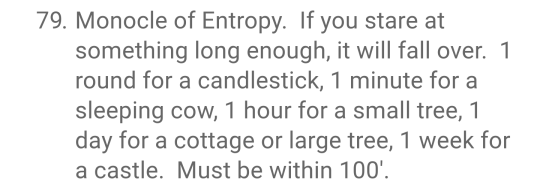
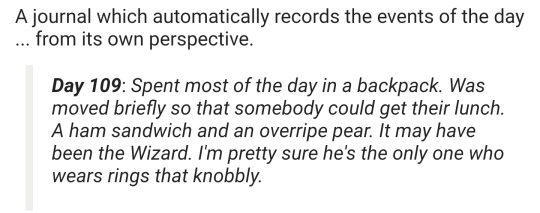
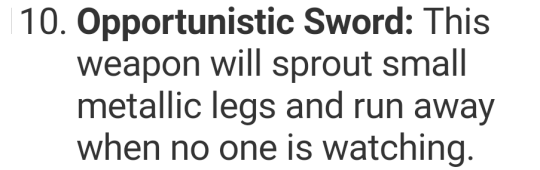
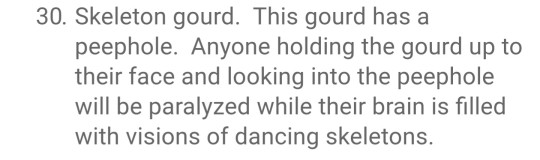
We decided to share with you some links with awesome ideas for loot (or your NPC merchants). The links below include (but are not limited to):
Belt of Pants: This belt creates illusory pants on the wearer. The wearer can suppress the illusion at will.
Digging Spoon: This tiny spoon can dig through any substance with a forceful push.
Hungry coin: Cursed. Will attempt to eat other coins that it comes into contact with. Eats 100 coins an hour.
Crossbow of Whispers (Weapon, light crossbow): You can use an action to whisper a message and fire a bolt from this weapon at a target within range. If you hit, the target (and only the target) hears the message.
Scroll of Cure Blindness: Cures blindness when read.
101 Silly/Useless Magic Items – You need to read through 7 pages of the thread but there are some very nice ideas!
1001 most useless (dungeons and dragons) magical items – There are actually 21 of them on this list but they are really useless. It could be nice to drop something like that on the players so they can have some fun…
Now I will let @princeofsparrows to continue. He still has some things to add 🙂
The great thing about a lot of these items is that, despite their apparent uselessness, as with most things in D&D, an innovative player can find some use for it… and I feel it throws a bit of a wrench into the mix. Here are some other honorable mentions:
I figured out a simple guide to the alignment chart last night
Lawful: Rules matter more to me than individuals. Chaotic: Individuals matter more to me than rules.
Good: Other people’s well-being is more important than my own. Evil: My own well-being is more important than other people’s.
Neutrals: My opinion of what is more important is determined on a case-by-case basis.
So a Lawful Good character’s guiding moral philosophy might be “I follow the rules because the rules keep people safe, even if they are sometimes inconvenient or harmful to me or other individuals.” A Chaotic Evil character’s guiding moral philosophy would be like “Screw the rules and screw you.”
Characters in the tags, askbox open, character synchronization set to maximum! Throw a number or two in my askbox along with a character, and I’ll answer those questions!
1. How many dead parents do they have?
2. How good are they at tongue twisters?
3. Biggest regret?
4. Are they formally trained or have they gone through a more organic learning experience for their skillset?
5. If they could hang out with one famous person in 18th century American History, who would they want to hang out with?
6. What’s their theme song?
7. What fictional character are they most like? Was this an intentional or accidental influence?
8. Paper or plastic?
9. What’s their dump stat?
10. What’s their best stat?
11. What is their favorite anime?
12. What’s their favorite beverage?
13. If they can use magic, what’s their favorite spell?
14. Most heroic thing they have ever done?
15. Most despicable thing they have ever done?
16. Are they a hero or a supporting protagonist?
17. What’s their favorite food?
18. Would they rather fight a hundred duck-sized horses, or one horse-sized duck?
19. They have to go live on a deserted island. They can take one thing and one person. What do they take?
20. Are they religious? If so, what god or gods do they serve?
21. How did they become an adventurer?
22. Most amazing monster they have ever killed or helped kill?
23. Thoughts on death?
24. Do they have any interesting skills?
25. Favorite animal?
26. Expansion of civilization or the preservation of nature?
27. They’re at a tavern. They bump into a big burly angry drunk with a combative attitude. What happens?
28. What do they do between quests?
29. Biggest positive and negative influences on their life and development?



 Site Title