High school cliques: the jocks, the theatre kids, the anime fans, the stoners, and the motley crew of weirdos who don’t seem to have any discernible commonality but are all inexplicably drawn to one another and feel a strange sort of kinship, who will all independently experience epiphanies a few years later when they realize they’re LGBTQ.
Aaaahhhhh I don’t think I have the brainpower rn to really explain exactly why I like them so much, except that I love everything about their coloring and their sense of atmosphere and place, their general vibe, how they give off a simultaneous air of being very artistically modern art in the true conceptual sense and of being very old and strewn with minor cues that ping as vaguely ancient. I love Tolkien’s sense of space and the feeling that he knew EXACTLY what he was looking at inside his head and believed in its existence and knew what it was supposed to feel like. Some faves:
Also, this week in our ongoing series “Marta queues a post, forgets about it, sees someone react to it after it posts, and only then realizes she has something to say”:
Read the Letters. Read the letters, children, because this successful Oxford professor is such a dweeb, down-talking his own art and having let’s just say some overly strong feelings about certain art, getting upset when early drafts or even finished works were shared wit third parties and sent to his publishers without his consent (reblog-don’t-repost if ever there was one).
Plus you get the joy of his editor hounding him for the long overdue intro to Beowulf which anyone who’s ever run or participated in an exchange will appreciate (“Sir, at this point I would gladly accept your shopping list, just give me *something*.) Then there’s the rather epic takedown when a WW2-era German publisher asked if he was of Jewish ancestry. The version he actually sent is lost to time, but the one his editor held back is hiLARious.
There’s also some pretty serious misogyny and low-grade racism, so you have to look past that. Not for everyone one that count. But not only is it fascinating with the canon tidbits he gives readers (Lalia! Denethor!), but as biography it’s just so charming. If you want a treat, dig through the discussions between him and his publishers over Hobbit illustrations. So much fun.
Seconded. 🙂 @marta-bee The German Nazi publisher actually asked Tolkien (who had German ancestors; his name comes from German *tollkühn*) to provide a so-called “Ariernachweis”, proof that he was of “Aryan” ancestry, without it The Hobbit was not to be published in Nazi Germany. Tolkien had some choice words to say about that. The Hobbit was only published in Germany in 1957.
Good catch. I’d point out Tolkien himself read the question both ways (or at least made hay of the ambiguity):
I regret that I am not clear as to what you intend by arisch. I am not of Aryan extraction: that is Indo-Iranian; as far as I am aware none of my ancestors spoke Hindustani, Persian, Gypsy, or any related dialects. But if I am to understand that you are enquiring whether I am of Jewish origin, I can only reply that I regret that I appear to have no ancestors of that gifted people. My great-great-grandfather came to England in the eighteenth century from Germany: the main part of my descent is therefore purely English, and I am an English subject – which should be sufficient.
Of course, it’s the sass rather than the specifics that are most important here, I think.
🙂 I didn’t mean to catch you at a mistake. It just always feels like such a vivid detail of what was happening in Germany, that even a British author like Tolkien was asked to provide an “Ariernachweis” to be able to have a children’s book published that it struck me. Of course, almost all German authors had to provide the “Ariernachweis” to be able to publish in their own country. Tolkien’s letter draft bears to be fully quoted as it poignantly expresses his sentiment in regards to Nazi Germany even before WWII:
… which should be sufficient. I have been accustomed, nonetheless, to regard my German name with pride, and continued to do so throughout the period of the late regrettable war [WWI], in which I served in the English army. I cannot, however, forbear to comment that if impertinent and irrelevant inquiries of this sort are to become the rule in matters of literature, then the time is not far distant when a German name will no longer be a source of pride. [Letter 30, 25 July 1938]
Oooh! A good and important question! It’s definitely something I’m still working on myself, and I might be incorporating a mechanic into the game that lets players accrue friendship points and use them to change the world, but here are some tips:
Don’t push it too hard at the beginning. It’s much more rewarding if these things develop at their own pace.
Down-time is your friend. Just think of how many good character bits we get during the Lunar interludes in TAZ! You can go the interlude route and have set time between missions where characters can go on sidequests and develop their relationships with each other and with the NPCs, but it’s something to think about all the time. Are they walking somewhere or pausing for a rest? Ask what they’re talking about. Are they going to bed after a long day? Let them narrate how they go about it and if they talk to any of their friends. I mean, really this is just an important characterization thing in general, but it’s also when we’ve had some good friendship moments.
Set up challenges that require the party to work together in different ways–not all based on strength and magical prowess–and give them time to debrief afterwards.
Use sparingly, but last week’s session proved that if you emotionally torture the party you will get a lot of hugs out of it!
Remember that different characters will have different ways of expressing their friendship and different rates at which they’re comfortable doing so. As you get a better sense of the characters, tailor your game and challenges to fit them.
As I said, I’m still learning, so if other people have advice they should feel free to add to this post!
i witnessed the most fascinating thing today imo…my 4th grade art class were talking while they did their work and one of them was like “if you work hard all your life…….it means NOTHING” and their response was to all crack up and start running with this bit like. “you work all your life on an oil painting. the mayor comes in. he says ‘i didn’t even ask you to do that painting.’” they kept going giving examples of nothing mattering and laughing hysterically. they’re 9. like, we think OUR humor is depressing or w/e, how are THEY going to be
Millennials are depressed but the Gen Z kids are straight up nihilists
Sibling rivalry is often a trite story of one sibling hating the other out of jealousy. On the surface, the Zuko and Azula may look that way. They have no problem blasting fire and lightning at each other and both of their parents had a favorite. But there’s so much more to it.
First of all, I would argue that in spite of many near-fatal encounters, they don’t necessarily hate each other. It’s far more complicated than that. How they view each other is closely tied to how they view themselves.
For most of Zuko’s life, Azula is the standard he’s held to. She’s ambitious, ruthless, and a prodigy. No matter what he does, he can’t earn their father’s approval like she can. And she rubs it in his face constantly. When Azula is cruel to Zuko, Ozai affirms that she’s not wrong to do so. Zuko rarely argues with her because he’s been conditioned to believe she’s right. Zuko has internalized the blame for how his father treats him rather than project it onto Azula, and accepts how she treats him as normal. He has plenty of bitter feeling toward her, but none quite as clear as hate.
Azula’s view of Zuko is even more convoluted. The first time we see Azula, she’s smiling because their father is about to burn him. The next time they meet, she berates him for being a failure of a son. It looks like she enjoys watching him suffer.
But when Zuko helps “kill” the Avatar in Ba Sing Se, we get to see them in a new context. In the rare moments that they aren’t pitted against each other by the ever looming presence of their father… they actually get along fine.
Every time Azula appeared happy to see Zuko suffering, it was at the hands of their father. It wasn’t just that Ozai hurt Zuko, it what that Ozai hurt Zuko and not her. Every time Ozai insulted or injured her brother, it cemented Azula’s position as the favorite child. And she had to stay the favorite child because she’s seen what would happen to her if she wasn’t. Deep down, she knows just how conditional her father’s positive regard is. When Ozai leaves her in the Fire Nation while invading the Earth Kingdom, the first words out of her mouth are “You can’t treat me like Zuko”. Being better than Zuko is part of her identity.
When Zuko defects from the Fire Nation and begins to succeed without meeting, or even trying to meet, the standards set by their father, it throws her priorities into doubt. In her mind, Zuko is supposed to fail. But she isn’t truly unnerved until she’s betrayed by Mai and Ty Li.
She is incapable of understanding why Mai would chose Zuko, and this drags to the surface her inability to understand why her mother preferred Zuko. She believed her mother loved Zuko and not her. Now Mai, her closest friend, loves Zuko and not her.
This conflicts with her entire view of the world. She sees the worth of a person as equal to their quantifiable skills and accomplishments. She has been admired, respected, and feared, but as far as Azula believes, no one has ever loved her. She was a prodigy who did everything right, while Zuko was the family screw up. Yet people loved him and not her.
For years, being better than Zuko was how Azula measured herself. Ozai said Zuko was lucky to be born. That he was worthless, weak, disrespectful, and both his children believed him. When Zuko left, he finally saw that Ozai was wrong about him. When Zuko returns during Sozin’s comet, Azula too is forced to see that her perception is wrong.
Zuko has become the embodiment of everything she lacks. She thought he was weak, but he’s not afraid enough to fight her fairly as an equal. She thought he was dishonorable, but really he was independent enough to break away from their father’s control. She thought he was worthless, but he’s found people who care about him in spite of his flaws.
Azula isn’t just trying to kill him, but everything he represents. And when she can’t, she breaks. Zuko is still standing. She has nothing left.
Word of God (Bryke) confirmed that at the end of the Agni Kai, Zuko felt pity rather than hate for his sister. This continues into the comics as he genuinely tries to help her. He knows that while she may not have been overtly abused like he was, she was raised in the same web of lies, agendas, and violence.
Their past left them both unable to trust people. Azula controlled everyone around her with fear. Zuko shut other people out and tried to do everything on his own. It isn’t until Zuko has left his old life behind that he slowly begins to let people in.
While Azula hangs onto the beliefs of Ozai and the Fire Nation, Zuko can see their situation from the outside. He sees two screwed up teenagers who spent their lives fighting their father’s war, manipulated into a conflict that isn’t their fault, forced to kill each other over choices made a century before they were born. It took Zuko years to figure out the hell that was his home life wasn’t his fault, but only a few minutes to see that it wasn’t Azula’s either.
So I was having a lovely conversation with @princeofsparrows about magic and magical items and he sent me several links to very useful lists and tables. Those can be used by any DM to improve the game and set some more fun/challenge into the game without adding enemies or limiting themselves to always better armors and weapons.
My players usually discuss for an hour about the best way to open every door with a single rune on it (even if the rune actually just means “toilets”). So if I give them an omniously glowing fork and they will turn around it for half of the evening…
We decided to share with you some links with awesome ideas for loot (or your NPC merchants). The links below include (but are not limited to):
Belt of Pants: This belt creates illusory pants on the wearer. The wearer can suppress the illusion at will.
Digging Spoon: This tiny spoon can dig through any substance with a forceful push.
Hungry coin: Cursed. Will attempt to eat other coins that it comes into contact with. Eats 100 coins an hour.
Crossbow of Whispers (Weapon, light crossbow): You can use an action to whisper a message and fire a bolt from this weapon at a target within range. If you hit, the target (and only the target) hears the message.
Scroll of Cure Blindness: Cures blindness when read.
101 Silly/Useless Magic Items – You need to read through 7 pages of the thread but there are some very nice ideas!
1001 most useless (dungeons and dragons) magical items – There are actually 21 of them on this list but they are really useless. It could be nice to drop something like that on the players so they can have some fun…
Now I will let @princeofsparrows to continue. He still has some things to add 🙂
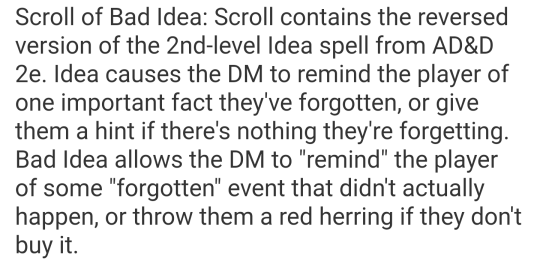
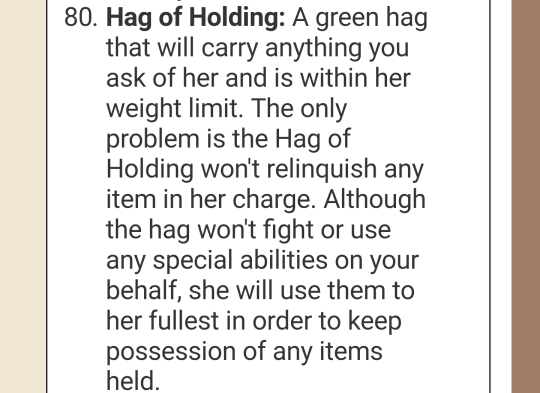
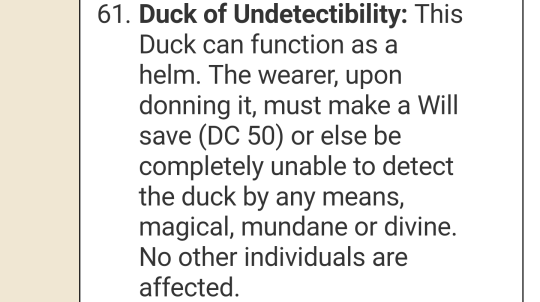
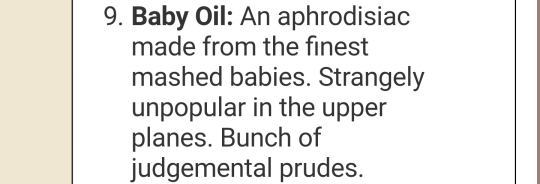
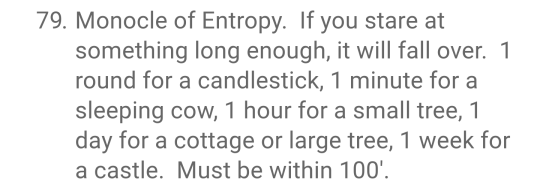
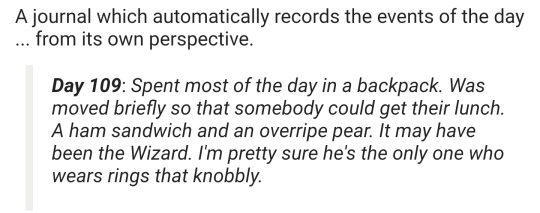
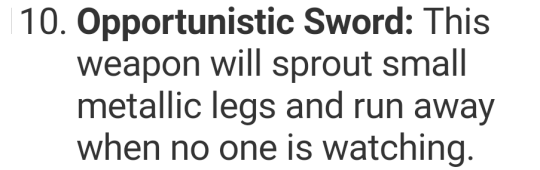
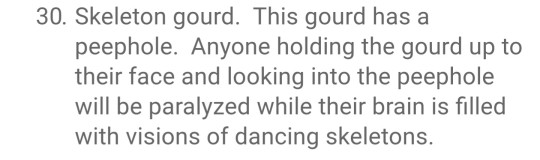
The great thing about a lot of these items is that, despite their apparent uselessness, as with most things in D&D, an innovative player can find some use for it… and I feel it throws a bit of a wrench into the mix. Here are some other honorable mentions:



 Site Title