i love the term “partners” are we dating? are we robbing a bank? do we run a legal firm? are we the dedicated detectives who investigate these vicious felonies and are members of an elite squad known as the special victims unit? who knows.
I was told doing studies of classical paintings is good practice. So I started doing that and then things took a turn…
Here is unofficial “official” potraiture of The House of de Rolo. I think it’s about time I drew my favorite member of Vox Machina… Trinket! Featured here with his mom and step-dad, Vex’ahlia and Percival de Rolo.
I’ll post close-ups later along with the original paintings I referenced. For now I’m on a time crunch. EDIT: The close-ups are here.
People keep asking who would do all the menial jobs if they didn’t have the threat of starvation hanging over their heads, but in my experience there are plenty of people who would be overjoyed to spend all day running minor errands for folks if they were allowed to tell the rude ones to fuck off.
If money wasn’t a problem, I actually enjoy the physical labor of my job and the sense of fulfillment at having something concrete I can look at and accomplish—it’s the being treated like a vending machine/punching bag while also making barely liveable wages that make the whole thing suck, not the work itself
I really enjoyed the tetris like feel of bagging groceries and stocking shelves for years. What wore me down was the inconsistent hours, bad pay, poor treatment of workers overall (they treated the elderly employees especially horribly) and nasty customers who I couldn’t tell off.
For more pay, and more protection, I’d have happily stayed for a while longer.
I absolutely LOVE working early hours making coffee and tea and donuts and all that. I would fucking show up at 4am in the morning to work in a coffee shop that doesn’t have a manager constantly screaming at how long the line is and how many sales we need to make in an hour to reach our quota.
Like, I just really enjoy making food and mornings and people.
Yeah tbh I really like selling phones and helping people understand their technology, I love helping people in general, if malwart wasn’t such a hell hole it’d be perfect
“But who would do all the menial jobs if we didn’t threaten people with starvation?”
Have you considered making them not menial?
1.(of work) not requiring much skill and lacking prestige.“menial factory jobs"synonyms:unskilled, lowly, humble, low-status, inferior, degrading;
The degradation of these jobs and the workers who do them is artificial and deliberate, made to justify the low wages and help reinforce the system that keeps people doing them despite said degradation.
It is entirely possible to create workspaces where the people who do these jobs are treated well, valued, allowed comfort and boundaries. This is a thing we can do.
I loved being the front-desk receptionist for my company. I had lots of time to read and write. I wrote and published a novel a year as a receptionist; since leaving that job I’ve written three and published one in seven years. I enjoyed making sure everyone got the help they needed, and I even liked taking phone calls. I liked being in a union job. I was good at it and everyone in the company knew me and knew I could help them if they had a problem.
I just couldn’t live long-term on what they were paying me, especially since without the union-mandated cost of living raises I would never get a raise at all. If I earned then what I’m earning now, with the merit raises I now get, I never would have left it.
There’s a lot of small details that I’m going to yell about that are amazing in this issue, most especially how much Yoda loves his grandkid and encourages him to question things, but first I’m going to get right to the heart of what’s going on here: Qui-Gon is questioning the Jedi’s path, about them being situated on Coruscant instead of some distant world where they’d be even further away from interacting with other people, questioning about how they work for the Senate, questioning how they fight battles.
And, honestly, pretty much all of this lines up with exactly how I see things. Ultimately, being part of the Republic is what dooms the Jedi. Ultimately, being under the jurisdiction of the Senate is what dooms the Jedi. Ultimately, fighting in the clone wars is what dooms the Jedi. Do I think these were missteps? Yeah, of course. But I think this issue also does a solid job of illustrating why those missteps were taken.
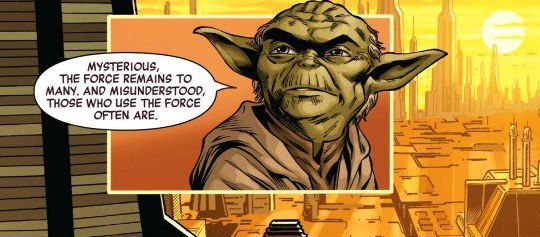
We see in the Jedi of the Republic – Mace Windu comic that people don’t understand and fear the Jedi. We see that all throughout The Clone Wars, people fear and misunderstand the Jedi. We see it mentioned several times when the Jedi come up in Star Wars Propaganda. And Yoda himself says it right here:
People fear what they don’t understand. And Qui-Gon’s solution is basically to distance themselves even further from those people? I think it’s pretty safe to say that wouldn’t have worked, either.
And that’s why Qui-Gon can’t find answers by the end of the issue. He goes on his Force-woo journey, he has a bunch of scary visions, and ultimately says, “Violence sows the seeds of the dark side. Unchecked, the Jedi could become that which we fight against.” And the very next page is him going to the Priestess of Wood and telling her that she should go talk to people on Coruscant, should reach out to them and create more allies. To be more connected to this planet of metal. That the whole point isn’t isolating themselves further, but instead working with the system. Not going around unchecked, but instead having a system that helps them stay in their lane and forge allies. (It’s only that the system they’re checked by happens to be in a moral decay spiral.)
The page immediately after his Force-woo vision has him saying:
“You may see it as a city of metal, but there is wisome to be found here. And allies.”
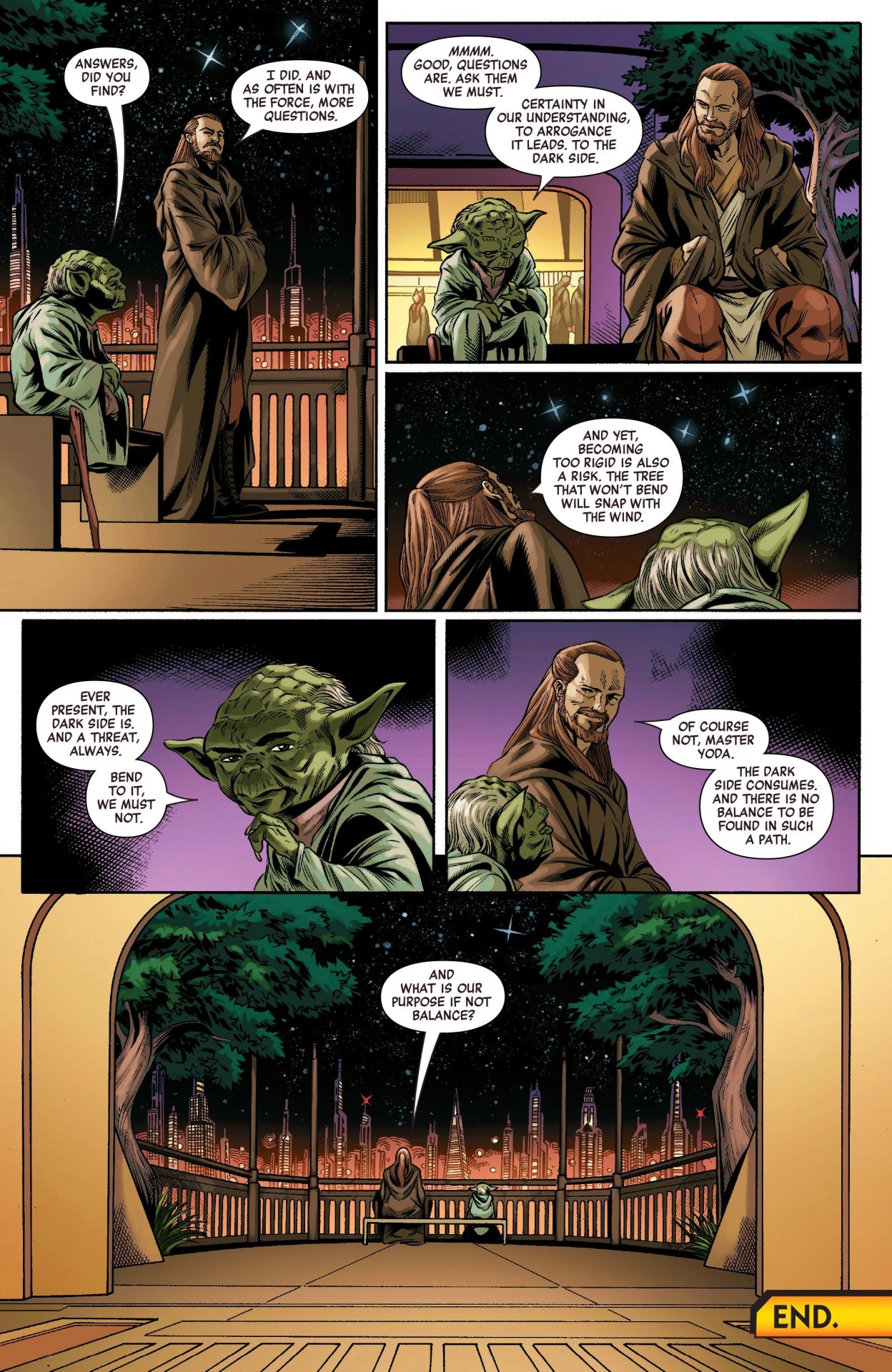
And then the final page with him going back to talk with Yoda, saying, yes, he found some answers (which are apparently, “Coruscant’s not so bad, I guess”) and they talk of how they have to find balance between not bending to the dark side, but still being flexible in how they approach things.
You cannot clip any one piece of conversation out of this issue and take it out of context, because it’s a single story that’s meant to have themes, which means the ending is just as important as the middle (if not more so in some ways) and the ending is that: this is a quandary that doesn’t really have a good answer.
THAT’S THE WHOLE IDEA. THIS IS A QUANDARY THAT DOESN’T HAVE AN ANSWER. There’s no simple, easy answer, no matter how much Force-woo shenanigans Qui-Gon has or how many conversations he has with Yoda. Even in hindsight, knowing how the story goes, we don’t have an answer for how the Jedi could have avoided this.
Leave Coruscant? They’d have been fucked twice as hard, because people feared and mistrusted and misunderstood them even when they were already at the hart of the Republic.
Leave being part of the Republic/the jurisdiction of the Senate? They would be able to help no one, they would have no allies, they would be allies to no one in return.
Stop fighting battles? And instead just let people suffer and die?
This is the conclusion Qui-Gon reaches when he goes on his Force Walk: He ends up with more questions than answers. He has some answers, but not enough to see things clearly. Not enough to clear a path forward.
That’s it, that’s the whole thing. It’s not that the Jedi didn’t think about this stuff, they clearly did. Obi-Wan questions it fairly often in The Clone Wars, about their greater path. Yoda has several big speeches about it. But there were no other answers. Even when I look back with full hindsight and go, “What should they have done differently?” I can’t really come up with an answer, because every option I come up with, there’s another counter-move Palpatine could have made. Not fight in the Clone Wars? They’d have been ripped to shreds by the Republic for not helping, as well as they’d have had to stand by and let people die. Etc.
Ultimately, this comic just further illustrates to me that, no, the Jedi aren’t perfect, but every time we see them (and it’d have been fascinating to get the perspective of the Council, we don’t actually hear anything from them or their side of things) they care deeply and are trying to figure out the best thing to do and are encouraging people to learn and question and do their best. GOD, THEY WERE SO GOOD, THERE WAS SO MUCH LIGHT WITHIN THEM, THEY CARED SO MUCH AND WANTED TO HELP SO MANY PEOPLE AND I’M JUST GONNA CRY ABOUT THEIR LOSS, THAT THIS IS WHY THEY WERE THE BIG THREAT TO PALPATINE, THIS IS WHY HE ABSOLUTELY HAD TO EXTINGUISH THEIR LIGHT FROM THE GALAXY.
there’s a long version that expresses a cogent critique of the issues with Campbell and the idea of the Hero’s Journey here that I didn’t write but wholeheartedly agree with. if you want the tl;dr version, though, it basically boils down to two things:
1. I am profoundly uncomfortable with universalizing definitions and conceptions of storytelling. “All stories look like this” is, in my opinion, an incredibly reductive and boring way of analyzing literature (or myth), and more often than not also just isn’t accurate.
2. I just straight up don’t buy any universal theory of myth. At all. Ever. And that’s what the Hero’s Journey is – a universal theory of myth. Looking for patterns in storytelling is one thing, and can be interesting (though I personally find universalizing studies of myth/folklore/religion to be generally suspect), but when you start to assume that stories are going to fit a specific mold then you’re going to start making them fit this mold.
I find it much more interesting to look at the way post-Campbellian writers tend to fit themselves into a Campbellian story structure, but I still can’t find the essay I read about that once.
3. The Campbellian approach specifically involves flattening and effacing cultural differences in favor of this universalizing impulse – one of the posts I’ve reblogged about Mr. Campbell refers to this as “soft colonialism” and I think that’s a great way of putting it: it’s “colonialism by soft-focus lens, where we sweep little things like cultural and ethnic distinctions under the beaded prayer rug and can rejoice in our oneness without having to do too much thinking.”
while searching around, found this article on Why Folklorists Hate Joseph Campbell which is good stuff that further (and again, more cogently) expresses all of this.
By far the most obnoxious shipping phrase has to be, “How could anyone see it as anything BUT romantic?”
…Pretty easily actually
I’m aromantic, everything is platonic to me, especially between two characters who haven’t kissed or expressed explicit romantic interest.
All those things that you insist are signs that they love each other? I’d do them for my friends and it kind of sucks that there’s this undercurrent of, “They care too much for the relationship to be platonic because platonic relationships are inferior to romantic ones” to the phrase too





 Site Title